
Mangroves are incredibly productive and diverse ecosystems that can be found all over the world in coastal wetlands. These plants have amazing adaptations that help them survive in challenging environments, and they provide a wide range of benefits to local communities. Ecosystem services are like the perks we get from nature, showing just how valuable natural resources are for our well-being and sustainability. According to the Millennium Ecosystem Assessment (MEA), these services can be divided into four categories: things like food resources, climate regulation, cultural activities such as tourism and recreation, and the support they provide to various habitats. The MEA aimed to provide decision-makers and the general public with scientific data on how global change impacts ecosystems and, in turn, how that affects us. Mangrove forests offer numerous ecosystem services that benefit both local communities and the global environment (Figure 1). So, here are some really cool examples of what mangrove ecosystems can do:
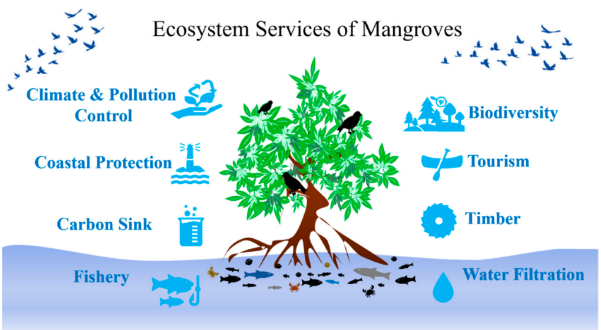
Figure 1: Examples of cool things mangrove ecosystems do. (Source: Lai et al., 2022)
Fishing: Mangroves are super important for supporting fisheries and providing food for coastal communities worldwide. The detritus and organic matter in mangrove forests nourish the fish and other aquatic critters, creating a whole food web in coastal ecosystems. Mangroves are awesome habitats for fish and shrimp, making them really productive (Eddy et al., 2016).
Wood stuff: People are using mangroves more and more for things like timber, poles, fuel wood, and charcoal. Mangrove wood is in high demand because it doesn't rot or get eaten by bugs. Local communities in coastal areas benefit a lot from these resources, and it helps the economy too (Hussain & Badola, 2010).
Medicine: Mangrove plants have natural chemicals that are really strong and can help with things like heart disease, diabetes, high blood pressure, and cancer. There are specific mangrove species, like Bruguiera gymnorhiza (L.) Lam, Rhizophora mucronata Lam, and Acanthus ilicifolius L., that have been used to treat different illnesses (Bibi et al., 2019).
Protecting the coast: Mangroves do a great job of keeping coastal areas safe from storms and waves. They help reduce the strength of currents and waves, prevent erosion, and cause sediment to build up in the forest. Because of mangroves, flooding and erosion are less likely to happen, which means less property damage and risk in coastal areas (Menéndez et al., 2020).
Storing carbon: Mangrove forests are really good at storing carbon. In fact, they can store more carbon per hectare than tropical forests on land. They do this by sequestering carbon in the trees and in the sediment. This is really important for reducing carbon emissions and fighting climate change (Hatta et al., 2022).
Regulating nutrients: Mangrove forests play a big role in moving organic matter and nutrients to the ocean. The tides bring in nutrients from the ocean, and the forest floor and creeks soak them up. This cycling of nutrients helps keep the mangroves productive and healthy (Alongi, 2018).
Habitat and Biodiversity support: The mangrove environment plays a super important role in supporting the survival of lots of different animal and plant species including all sorts of life like bacteria, fungi, algae, bugs, birds, and animals (Reef et al., 2010). These ecosystems are like really important homes for many different animals, providing them places to have babies, hide, build nests, and eat, including baby fish and sea creatures that migrate.
Tourism and recreation: Mangrove forests are great for eco-friendly tourism, which helps the local economy and creates jobs (Kurniawati et al., 2022). Plus, you can do lots of fun stuff in mangroves like hiking, boating, fishing, and watching wildlife because they are so beautiful, have lots of different species, and are super peaceful.
Water purification: Mangroves are also really good at cleaning up wastewater from fish farms, sewage, and other sources, which is especially important as cities keep growing (Ouyang & Guo, 2016). The intricate root systems of mangroves are like experts at catching all the dirt, nutrients, and yucky stuff, so it doesn't get into the water. They make the water cleaner and protect the homes of coastal animals from pollution and runoff.
Education and knowledge: Mangroves also help us learn and educate others (Scemama et al., 2022). Eco-tourism also helps people become more aware of the environment and different cultures through cool programs like guided tours and teaching people about why we need to take care of mangroves can help protect all the important things they do for us and the coast.
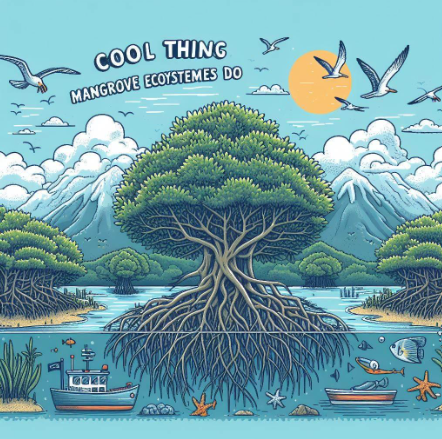
So, basically, mangrove ecosystems are like the superheroes of the natural world. They do all kinds of cool stuff for us without us even realizing it. They protect our shores from storms and provide homes for all sorts of critters, like ultimate multitaskers. And on top of that, they help filter our water and store tons of carbon dioxide, which is pretty awesome for fighting climate change. So next time you're just hanging out by the coast, take a moment to appreciate these amazing mangroves and all the awesome things they do for us. It's super important to protect and take care of mangrove ecosystems so we can keep reaping all these benefits and keep our coastal communities and homes safe.
REFERENCES
Alongi, D. M. (2018). Impact of global change on nutrient dynamics in mangrove forests. Forests, 9(10), 596.
Bibi, S. N., Fawzi, M. M., Zengin, G., Jeewon, R., Nazurally, N., Rengasamy, K. R., … & Pandian, S. K. (2019). Ethnopharmacology, phytochemistry, and global distribution of mangroves―a comprehensive review. Marine Drugs, 17(4), 231.
Eddy, S., Ridho, M. R., Iskandar, I., & Mulyana, A. (2016). Community-based mangrove forests conservation for sustainable fisheries. Journal of Tropical Silviculture, 7(3), S42-S47.
Hatta, S. M., Salleh, E., Suhaili, N. S., & Besar, N. A. (2022). Estimation of carbon pool at mangrove forest of Kudat, Sabah, Malaysia. Biodiversitas Journal of Biological Diversity, 23(9).
Hussain, S. A., & Badola, R. (2010). Valuing mangrove benefits: contribution of mangrove forests to local livelihoods in Bhitarkanika Conservation Area, East Coast of India. Wetlands Ecology and Management, 18, 321-331.
Kurniawati, B., Sulistyaningrum, N., Nugroho, G. D., Sunarto, S., Kusumaningrum, L., Rahawarin, Y. Y., … & Setyawan, A. D. (2022). Mangrove conservation efforts with the ecotourism development in the cengkrong mangrove ecotourism, trenggalek district, East Java, Indonesia. International Journal of Bonorowo Wetlands, 12(2).
Lai, J., Cheah, W., Palaniveloo, K., Suwa, R., & Sharma, S. (2022). A systematic review of the physicochemical and microbial diversity of well-preserved, restored, and disturbed mangrove forests: What is known and what is the way forward? Forests, 13(12), 2160.
Ouyang, X., & Guo, F. (2016). Paradigms of mangroves in treatment of anthropogenic wastewater pollution. Science of the Total Environment, 544, 971-979.
Reef, R., Feller, I. C., & Lovelock, C. E. (2010). Nutrition of mangroves. Tree Physiology, 30(9), 1148-1160.
Scemama, P., Régnier, E., Blanchard, G., & Thébaud, O. (2022). Ecosystem services assessment for the conservation of mangroves in French Guiana using fuzzy cognitive mapping. Frontiers in Forests and Global Change, 4.
