

Introduction
Environmental, Social, and Governance (ESG) is now a key way to measure how organisations perform on sustainability. As concerns about climate change and carbon emissions grow, sustainable wood-based products are receiving more attention as alternatives to fossil-based, carbon-heavy materials such as concrete, steel, and plastics. Products such as cross-laminated timber (CLT), wood composite panels, cellulose fibres, wood-based packaging, and biocomposites can help reduce environmental impacts, create social value, and improve supply chain governance.
Wood-Based Products and the Environmental (E) Dimension
The environmental part of ESG is especially important. Sustainable wood-based products help lower greenhouse gas emissions in two main ways: by storing carbon and by replacing other materials. Trees absorb carbon during photosynthesis, and this carbon stays in the wood as long as the product lasts, until it decays, is burned, or reaches the end of its life (Zhao et al., 2022; Wei et al., 2023; Fuller et al., 2025).
Wood products can also replace materials like concrete, steel, and plastics, which have higher carbon footprints. Research by Hassegawa et al. (2022) and Fuller et al. (2025) shows that using wood-based alternatives instead of fossil-based products can lower greenhouse gas emissions over the product's life cycle.
In construction, mass timber such as CLT is increasingly used because it reduces embodied carbon compared to traditional materials. While engineered wood products still face challenges related to cost, certification, and building regulations, technologies such as CLT and glulam are now seen as important ways to reduce carbon in construction and to store more carbon in buildings (Amiri et al., 2020; Oudjehane and Hamad, 2025).
The idea of a wood-based circular bioeconomy encourages the use of wood, forest residues, and lignocellulosic materials to produce valuable products such as biofuels, bioplastics, green chemicals, and biocomposites (Ali and Russell, 2025). This helps reduce waste and make better use of natural resources.
Wood-Based Products and the Social (S) Dimension
From a social perspective, the sustainable wood products industry helps rural communities grow and provides jobs in forestry, manufacturing, and the bioeconomy. Moving toward a wood-based bioeconomy also brings new business and income opportunities, especially in areas with lots of forests (Hassegawa et al., 2022; Ali & Russell, 2025).
Recent studies, especially in Europe, show that wood-based buildings can make indoor spaces healthier and more comfortable. The natural qualities of wood also support the physical and mental well-being of people living or working in these buildings (Alapieti et al., 2020; Hariadi & Carlisle, 2025).
Sustainable forest management certifications like the Forest Stewardship Council (FSC) and the Programme for the Endorsement of Forest Certification (PEFC) ensure that raw materials come from sources that respect workers' rights, protect local communities, and conserve biodiversity. These certifications also help consumers trust the wood products they buy.
Wood-Based Products and the Governance (G) Dimension
The governance part of ESG means organisations need to be transparent and accountable, and manage risks effectively. In the wood products industry, this includes tracking the origins of raw materials, adhering to forest certification standards, and clearly reporting ESG information.
Using chain-of-custody (CoC) systems lets companies check where their wood comes from and helps prevent illegal logging. This is important because poor forest management can damage an organisation's ESG reputation.
Today, more organisations are incorporating natural resource management, carbon reduction, and circular economy principles into their governance strategies. This change shows that both organisations and investors want more transparency, accountability, and better management of sustainability risks (Kim et al., 2025; Xia et al., 2023). Clear reporting also builds trust with investors and stakeholders in a company's sustainability efforts.
Challenges and Future Prospects
While wood-based products have many ESG benefits, there are still challenges. These include the risk of overusing forest resources, insufficient data on the global impacts of material substitution, and the need to improve the recycling and reuse of wood products at the end of their life.
Recent research highlights the need for more studies on what happens to wood products at the end of their life, how to reuse wood materials, and how to apply circular economy ideas throughout the wood product value chain.
Conclusion
Sustainable wood-based products help advance ESG by reducing carbon emissions, storing carbon over the long term, supporting communities, and improving supply chain governance. With the right policies, forest certifications, and new ideas in the circular bioeconomy, these products could drive a low-carbon and sustainable future. Organisations that want to improve their ESG performance should consider incorporating sustainable wood-based products into their sustainability plans.
References:
Alapieti, T., Mikkola, R., Pasanen, P., & Salonen, H. (2020). The influence of wooden interior materials on indoor environment: a review. European Journal of Wood and Wood Products, 78(4), 617-634.
Ali, A., & Russell, J. D. (2025). Accelerating the transition to wood-based circular bioeconomy: A literature review of current state, trends, opportunities, and priorities for future research. Current Forestry Reports, 11(1), 1-20.
Amiri, A., Ottelin, J., Sorvari, J., & Junnila, S. (2020). Cities as carbon sinks—classification of wooden buildings. Environmental Research Letters, 15(9), 094076.
Fuller, M. R., Baker, J. S., Daigneault, A., Guo, J., Lauri, P., Favero, A., ... & Sohngen, B. (2025). Global carbon storage in harvested wood products: a forest sector model inter-comparison. Environmental Research Letters, 20(11), 114021.
Hariadi, K. S., & Carlisle, S. (2025, May). A Literature Review on the Health Impacts of Wood and Mass Timber Buildings. In Carbon Leadership Forum, Bellevue, WA.
Hassegawa, M., Van Brusselen, J., Cramm, M., & Verkerk, P. J. (2022). Wood-based products in the circular bioeconomy: Status and opportunities towards environmental sustainability. Land, 11(12), 2131.
Kim, J., & Yang, W. (2026). Environmental, social, and governance (ESG) research: a systematic review of recent trends (2020–2024). Sustainable Development, 34(2), 1872-1900.
Oudjehane, A., & Hamad, J. (2025). Building a Greener Future: The Compelling Sustainability Case for Mass Timber Construction. Journal of Sustainable Development, 18(6).
Wei, X., Zhao, J., Hayes, D. J., Daigneault, A., & Zhu, H. (2023). A life cycle and product type based estimator for quantifying the carbon stored in wood products. Carbon Balance and Management, 18(1), 1.
Xia, Z., Sun, A., Cai, X., & Zeng, S. (2023). Modeling the evolutionary trends in corporate ESG reporting: A study based on knowledge management model. arXiv preprint arXiv:2309.07001.
Zhao, J., Wei, X., & Li, L. (2022). The potential for storing carbon by harvested wood products. Frontiers in Forests and Global Change, 5, 1055410.
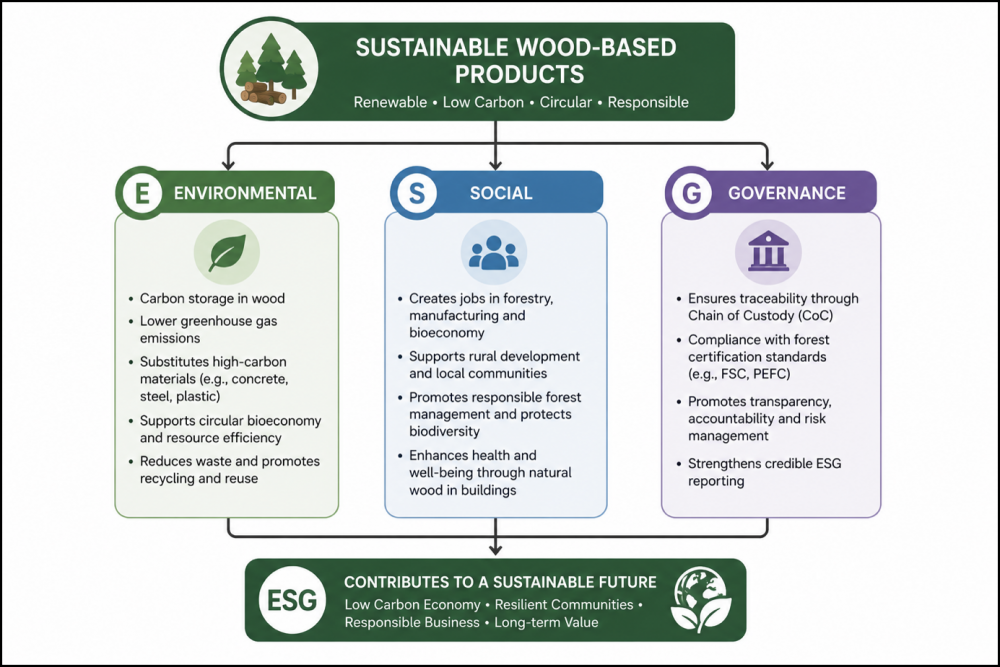
Contribution of wood-based products to supporting ESG commitments among industries, small and medium-sized enterprises (SMEs)
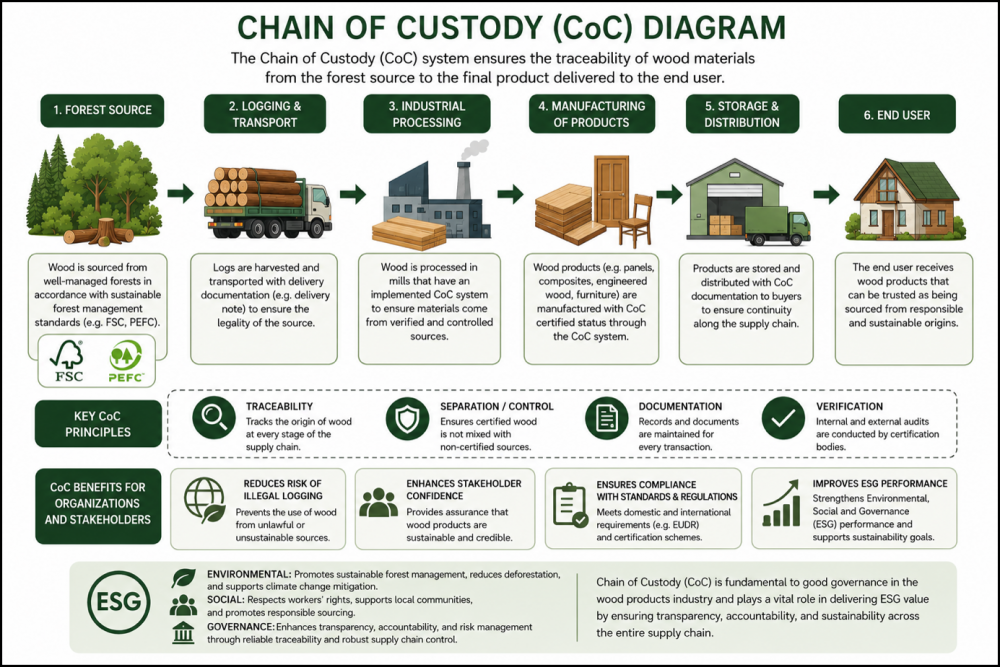
How the CoC system strengthens credibility and accountability in ESG reporting
