

Intensifying The Shift Toward Renewable Energy Amid Middle Eastern Geopolitical Uncertainty

A Boeing F/A-18E Super Hornet landing on USS George H.W. Bush. Source: The White House (openverse)
INTRODUCTION
The war in Iran early this year has triggered severe, unintended, and largely unfavourable repercussions for the global economy. Specifically, it has caused an energy shock driven by a near-total restriction of maritime traffic through the Strait of Hormuz. This restriction was imposed by Iran as part of its asymmetrical warfare strategy against the militarily superior US forces. Iran has sought to leverage this vital chokepoint as a diplomatic bargaining chip to secure broader geopolitical concessions, including sanctions relief, war compensation, or favourable resolutions regarding its nuclear program.
The consequences of this conflict extend far beyond the Middle East. Across the globe, disruptions to the flow of petrochemicals, such as crude oil and liquefied natural gas (LNG), through the Strait of Hormuz, coupled with extensive damage to oil-processing infrastructure, have naturally caused prices of fuel, food, and fertiliser to spike. Furthermore, industries reliant on petroleum products, such as pharmaceuticals, polymers, and automotive parts, face heightened uncertainty due to limited raw material supply. Ultimately, this conflict underscores just how vulnerable our reliance on fossil fuels is to regional instability.
In his keynote address at the Kuala Lumpur-Ankara Dialogue 2026, Prime Minister Datuk Seri Anwar Ibrahim acknowledged the challenges Malaysia faces due to these global energy disruptions, vowing to safeguard the wellbeing of the people despite the difficult circumstances. As part of a broader strategy to navigate this growing global uncertainty, the Prime Minister stated that the country “must accelerate a decisive shift towards more sustainable, diversified and cost-effective energy sources.”
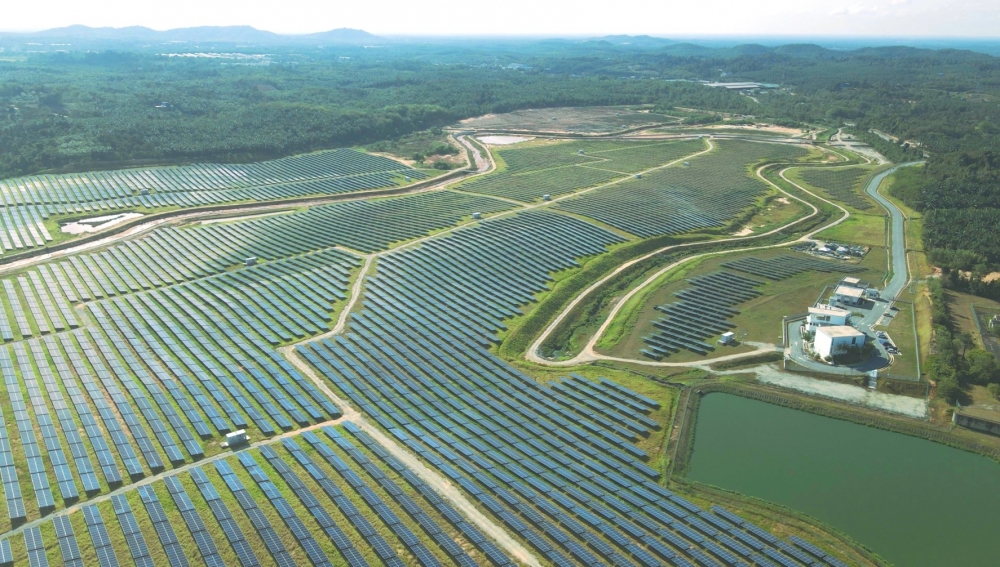
UiTM Solar Park I, Gambang, Pahang. Source: UiTM solar farm website
ENERGY ALTERNATIVES
New solar farms are popping up across the Malaysian peninsula, stretching from north to south. Anyone driving along the East Coast Expressway past Gambang can easily spot an extensive array of solar panels set up across vast fields, stretching to the horizon. This particular solar power plant belongs to UiTM Energy and Facilities Sdn. Bhd. The company currently owns two solar power plants: Solar Park I in Gambang and Solar Park II in Pasir Gudang.
1. Solar Park I, commissioned in 2019, consists of 180,000 solar panels. It generates a maximum theoretical capacity of 61MWp, which is enough to power 22,000 homes. Built at a cost of RM278 million and financed through Green SRI Sukuk, the plant is expected to generate RM650 million in revenue over 21 years.
2. Solar Park II, commissioned in 2020, features 91,000 solar panels that generate 31MWp to power 11,000 homes. It was constructed at a cost of RM125 million and is projected to bring in RM220 million in revenue over 21 years.
Another exciting renewable energy project currently under construction is the Nenggiri hydroelectric dam. This upcoming project is being undertaken by TNB Genco, a wholly owned subsidiary of TNB. The key novelty of this project lies in its integration of solar and hydroelectric power generation, aptly called the Hybrid Hydro-Floating Solar (HHFS) Photovoltaic (PV) system, which optimises power output per unit of land use. The dam is expected to be fully operational by 2027, with a capacity of 300MW, helping to meet the government’s ambition to increase the share of renewable energy to 40% by 2035.

Sao Paulo ethanol pump. Source: Mariordo Mario Roberto Duran Ortiz (openverse)
Internationally, Brazil provides a stellar blueprint with its decades-old policy to end dependence on foreign oil through the mandatory blending of ethanol and gasoline for automobiles. The country benefits from the successful, nationwide cultivation of sugarcane, which serves as the primary feedstock for bioethanol production. While the program was initially introduced during World War II due to threats to oil supplies from Germany, it remains highly relevant today. Amid the ongoing war in Iran, millions of drivers in Brazil now have the flexible option to fill their tanks with either 100% bioethanol or a 30% biofuel-gasoline blend.
A WORK IN PROGRESS
Malaysia is heading in the right direction toward achieving a 40% renewable energy mix by 2030 through multi-pronged, multi-faceted strategies. This roadmap includes the deployment of new renewable energy capacity backed by RM25 billion in investments from both the public and private sectors. To kickstart this momentum, the federal government has pledged RM2 billion in seed funds to accelerate new renewable energy projects. Ongoing efforts also include procuring large-scale PV plants totalling 4000 MW. Furthermore, in 2023, the Dewan Rakyat passed the Energy Efficiency and Conservation Act (EECA), which aims to improve energy efficiency by regulating energy consumption, particularly for large industrial and commercial users and large office buildings.
REFERENCES
Andritz Group (2022). More than just another dam. HydroNews.
Source: https://www.andritz.com/resource/blob/482402/06d26c4767946011618690cf01cc42cf/04-malaysia-nenggiri-data.pdf
Arfa Yunus (2026). Malaysia must speed up shift to more sustainable energy sources in light of global uncertainty, says PM. The Star.
Source: https://www.thestar.com.my/news/nation/2026/04/07/m039sia-must-speed-up-shift-to-more-sustainable-energy-sources-in-light-of-global-uncertainty-says-pm
Mauricio Savarese (2026). Brazil is uniquely positioned to weather rising world oil prices. Here is why. Associate Press.
Source: https://apnews.com/article/brazil-biofuels-sugarcane-ethanol-oil-prices-iran-war-bbdfcb49c0d3ceb86ceb8e25c1a25259
Mehdi Leman (2026). Iran war energy shock: 5 reasons renewables are ready to protect people from fossil fuel price spikes. Greenpeace
Source: https://www.greenpeace.org/international/story/83362/iran-war-energy-shock-renewables-wind-solar-fossil-fuel-price-spikes/
Pooja Menon and Pranav Mathur (2026). Iran war chokes petrochemical supply, sends plastic prices soaring. Reuters.
Source: https://www.reuters.com/business/energy/iran-war-chokes-petrochemical-supply-sends-plastic-prices-soaring-2026-03-26/
Shauqi Wahab (2024). TNB`s Nenggiri hydroelectric dam a step towards RE, community development. The Malaysian Reserve, Malaysia.
Source: https://www.tnb.com.my/assets/newsclip/26082024g.pdf
UiTM Solar Farm Project. Source: https://solar.uitm.edu.my/uitm-solar-farms/
