

Translocation of Pollutants in Plants
Introduction
Soil pollution occurs when harmful substances such as heavy metals, pesticides, hydrocarbons, and industrial chemicals accumulate in the soil, altering its natural composition and fertility. Plants growing in contaminated soil can absorb these pollutants through their roots, allowing toxic substances to enter their tissues and move to stems, leaves, fruits, or grains. This process, known as bioaccumulation, may impair plant growth by disrupting nutrient uptake, photosynthesis, and metabolic activities, ultimately reducing crop yield and quality. More importantly, when humans or animals consume plants contaminated with toxic elements such as cadmium, lead, or arsenic, these substances can accumulate in the body over time, potentially causing serious health problems, including organ damage, neurological disorders, and increased risk of chronic diseases. Therefore, soil pollution not only threatens plant health and agricultural productivity but also poses significant risks to food safety and human well-being.
Plants rely on clean water for essential physiological processes, including nutrient uptake, transpiration, and photosynthesis. However, water can become polluted (Figure 1) by various sources, including sewage discharge, industrial waste, agricultural runoff, mining activities, and drainage from paved surfaces (Nathanson, 2018). When water is contaminated, pollutants not only impair plant growth but may also be absorbed and transferred along the food chain, affecting animals and humans who depend on plants for survival (Denchak, 2023). The effects of water contaminants on plant morphology are concentration-dependent and can be observed through changes in leaf size and shape, phyllotaxy, stem diameter, internode length, root length, flowering time, pollen tube growth, fruiting delay, abscission zone development, and stomatal closure (Singh et al., 2023). In addition to morphological changes, water pollution significantly disrupts biochemical and metabolic activities, including photosynthesis, respiration, nutrient uptake, transpiration, and water conductance. Heavy metals, including cadmium (Cd), chromium (Cr), copper (Cu), nickel (Ni), lead (Pb), selenium (Se), vanadium (V), and zinc (Zn), are common water contaminants. These metals promote the generation of reactive oxygen species (ROS), which disturb metabolic processes and may lead to premature plant death. Although some plants can tolerate heavy metal stress by producing anthocyanins, thiols, and antioxidants, organic pollutants continue to pose serious risks to plant systems (Mohamed, 2025).
Plants rely on clean water for essential physiological processes, including nutrient uptake, transpiration, and photosynthesis. However, water can become polluted (Figure 1) by various sources, including sewage discharge, industrial waste, agricultural runoff, mining activities, and drainage from paved surfaces (Nathanson, 2018). When water is contaminated, pollutants not only impair plant growth but may also be absorbed and transferred along the food chain, affecting animals and humans who depend on plants for survival (Denchak, 2023). The effects of water contaminants on plant morphology are concentration-dependent and can be observed through changes in leaf size and shape, phyllotaxy, stem diameter, internode length, root length, flowering time, pollen tube growth, fruiting delay, abscission zone development, and stomatal closure (Singh et al., 2023). In addition to morphological changes, water pollution significantly disrupts biochemical and metabolic activities, including photosynthesis, respiration, nutrient uptake, transpiration, and water conductance. Heavy metals, including cadmium (Cd), chromium (Cr), copper (Cu), nickel (Ni), lead (Pb), selenium (Se), vanadium (V), and zinc (Zn), are common water contaminants. These metals promote the generation of reactive oxygen species (ROS), which disturb metabolic processes and may lead to premature plant death. Although some plants can tolerate heavy metal stress by producing anthocyanins, thiols, and antioxidants, organic pollutants continue to pose serious risks to plant systems (Mohamed, 2025).
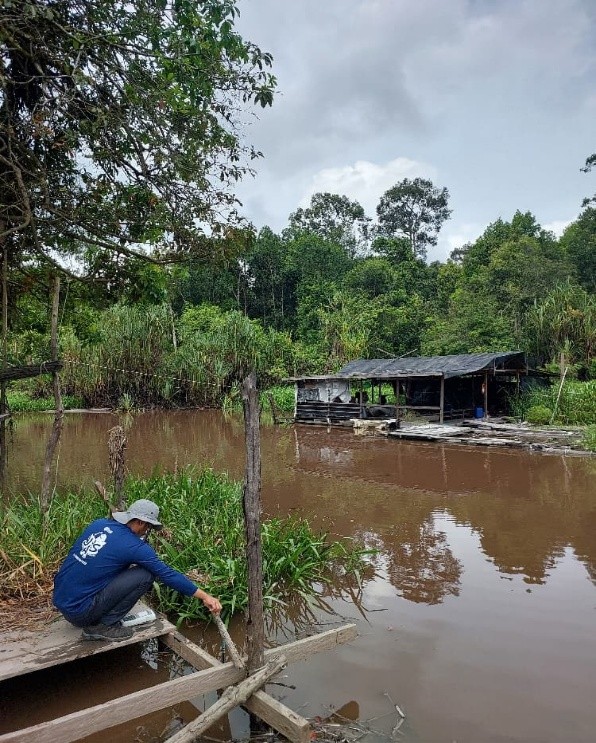
Figure 1: Anthropogenic causes of river pollution
Approach
The experiment, aimed at enhancing understanding of how foreign substances (pollutants) in water affect plant systems (Figure 2), was set up for the Pollution Biology Course at the Department of Environmental Science and Technology, Faculty of Forestry and Environment (FHAS), Universiti Putra Malaysia (UPM). Coloured dyes serve as simple and effective tracers to visualise water movement within plant tissues. In the study, celery (Apium graveolens), which contains distinct xylem vessels, is used to observe the movement of red food colouring at different concentrations through the vascular system. Celery stalks, with and without leaves, are placed in three treatments: plain water (control), low dye concentration (5 drops), and high dye concentration (10 drops), and observed over four days. Dye uptake through the xylem is monitored by examining changes in vein and leaf colour intensity, stalk firmness, and the time required for wilting. By comparing control samples with treated samples, the experiment simulates how plants respond to varying levels of external substances in their environment. A small section of leaf and a thin slice of stem were cut and placed on a glass slide for microscopic examination. The stem cross-section and leaf structures were observed using a microscope with a 10× eyepiece lens and 4× and 10× objective lenses, and clear images were captured. The findings illustrate how pollutants can move through vascular tissues, potentially disrupting physiological processes and overall plant health, thereby emphasising the importance of clean water for plant survival.
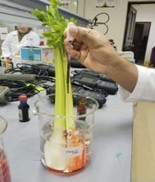
Figure 2: Experiment setup: (a) Adding red dye (5 drops and 10 drops) into the beaker;
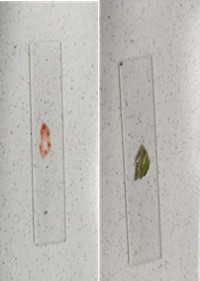
(b) A slice of celery stem and leaf placed on a glass slide for observation;
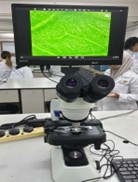
(c) Observation of the leaf vein under a microscope
Stems observation
In the dye-treated stems (5 and 10 drops), progressive staining of the xylem confirmed translocation of the coloured solution, accompanied by increasing physiological stress (Figure 3) compared to the control. At 5 drops, dye movement was gradual, with mild plasmolysis evident by Day 3 and Day 4 as the external solute concentration began to affect osmotic balance and water uptake. At 10 drops, the higher solute concentration further reduced hydraulic conductivity due to increased viscosity, which slows xylem flow (Tyree and Zimmermann, 2002), and decreased the water potential gradient necessary for effective absorption (Taiz and Zeiger, 2015). Consequently, stems exposed to higher dye concentrations exhibited greater cellular shrinkage, reduced turgor, and tissue softening. These findings simulate real agricultural conditions in which excessive fertiliser, salt, or pollutant levels impair water transport, reduce plant vitality, and negatively affect growth and crop quality (Kramer and Boyer, 2022; Salisbury and Ross, 2020).
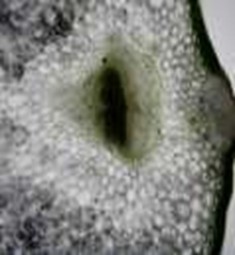
Figure 3: Stem cross-sections observed under a microscope at 4× magnification: (a) Control xylem,
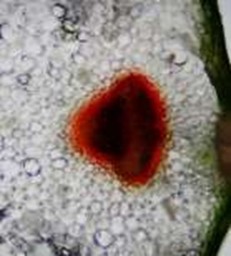
(b) Xylem treated with 5 drops of red dye,
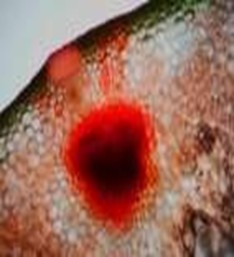
(c) Xylem treated with 10 drops of red dye after 4 days observation
Leaves observation
In the dye-treated samples (5 and 10 drops), the colour intensity within the veins progressively increased over four days, demonstrating dye translocation through the vascular tissues (Figure 4) compared with the control. At 5 drops, dye movement was gradual, with moderate colouration of xylem vessels and early signs of reduced cell turgidity by Day 3 and Day 4, suggesting mild osmotic interference with water balance. At 10 drops, the higher solute concentration significantly reduced hydraulic conductivity and water potential gradients, thereby slowing water uptake and intensifying wilting symptoms. Increased solution density lowers hydraulic efficiency (Tyree and Zimmermann, 2002), while elevated external solute concentrations reduce water potential differences necessary for effective absorption (Taiz and Zeiger, 2015). Consequently, leaves exposed to higher dye concentrations exhibited greater cellular shrinkage, pigment accumulation, and loss of firmness, modelling how excessive solutes, salts, or pollutants in water can impair vascular transport, decrease turgor pressure, and ultimately reduce plant health and productivity (Kramer and Boyer, 2022; Salisbury and Ross, 2020).
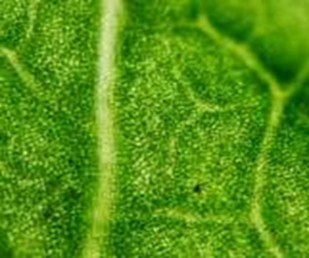
Figure 4: Leaves cross-sections observed under a microscope at 10× magnification: (a) Control vein,

(b) Vein treated with 5 drops of red dye,
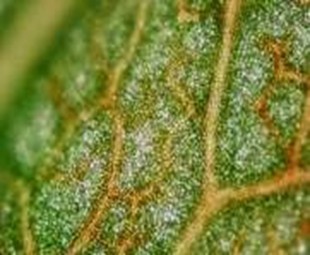
(c) Vein treated with 10 drops of red dye after 4 days observation
Conclusion
In conclusion, the experiment illustrates that xylem water transport and plant turgor are sensitive to changes in external solute concentrations. High solute levels, whether from pollutants, salts, or other contaminants in the soil, can reduce water uptake, cause cell shrinkage, weaken tissue structure, and lead to wilting in the stems and leaves of plants. These findings highlight how soil pollution can negatively affect plant health, growth, and resilience, emphasizing the importance of maintaining clean and balanced soil conditions for sustainable agriculture and ecosystem stability.
References
Kramer, P. J., and Boyer, J. S. (2022). Water Relations of Plants and Soils. Academic Press.
Denchak, M. (2023, January 11). Water Pollution: Everything You Need to Know. NRDC. https://www.nrdc.org/stories/water-pollution-everything-you-need-know#effects
McElrone, A. J., Choat, B., Gambetta, G. A., and Brodersen, C. R. (2013). Water transport in plants: physiology and pathophysiology. Annual Review of Plant Biology, 64, 455–476.
Mohamed, H. I., Ullah, I., Toor, M. D., Tanveer, N. A., Din, M. M. U., Basit, A., ... and Rehman, M.U. (2025). Heavy metals toxicity in plants: understanding mechanisms and developing coping strategies for remediation: a review. Bioresources and Bioprocessing, 12(1), 95.https://link.springer.com/article/10.1186/s40643-025-00930-4
Nathanson, J. (2018). Water Pollution. In Encyclopædia Britannica. https://www.britannica.com/science/water-pollution
Salisbury, F. B., and Ross, C. W. (2020). Plant Physiology. Cengage Learning.
Singh, N., None Sourabh, Kumar, P., None Preeti, and Mehta, S. (2023). Plant responses to water pollution. Elsevier EBooks, 253–64. https://doi.org/10.1016/b978-0-323-99978-6.00003-0
Taiz, L., and Zeiger, E. (2015). Plant physiology and development. New York Sinauer Associates, Oxford University Press.
Tyree, M. T., and Zimmermann, M. H. (2002). Xylem structure and the ascent of sap. Springer.
