
Planetary Health and the Cost of Delayed Action
Introduction
Planetary health refers to the close connection between human health and the well-being of the planet. Our homes, the food we consume, the water we drink, and the air we breathe all depend on a healthy, safe environment. This highlights how issues like deforestation, biodiversity loss, and climate change directly affect our well-being and emphasises the importance of protecting the environment for both present and future generations. This concept is well understood by indigenous populations who have long experienced its effects. Their experiences demonstrate how healthy forests, clean rivers, and stable seasons are linked to identity, spirituality, food security, and traditional medicine, showing that environmental damage is also a form of cultural and health injustice. Despite this longstanding awareness, global efforts to address deforestation, biodiversity loss, and climate change have been slow, allowing risks to accumulate and costs to rise over time. Through the lens of forests and the Sustainable Development Goals (SDGs), this reaction paper examines the health of the world and argues that delaying action now will make it far more difficult and expensive to protect ecosystems and human well-being in the future.
Planetary health refers to the close connection between human health and the well-being of the planet. Our homes, the food we consume, the water we drink, and the air we breathe all depend on a healthy, safe environment. This highlights how issues like deforestation, biodiversity loss, and climate change directly affect our well-being and emphasises the importance of protecting the environment for both present and future generations. This concept is well understood by indigenous populations who have long experienced its effects. Their experiences demonstrate how healthy forests, clean rivers, and stable seasons are linked to identity, spirituality, food security, and traditional medicine, showing that environmental damage is also a form of cultural and health injustice. Despite this longstanding awareness, global efforts to address deforestation, biodiversity loss, and climate change have been slow, allowing risks to accumulate and costs to rise over time. Through the lens of forests and the Sustainable Development Goals (SDGs), this reaction paper examines the health of the world and argues that delaying action now will make it far more difficult and expensive to protect ecosystems and human well-being in the future.
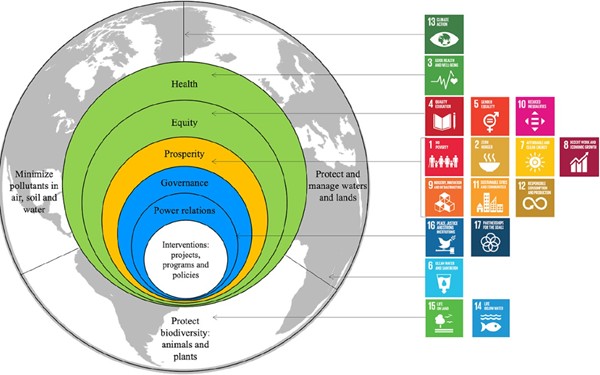
A theory-based approach to designing interventions for Planetary Health (Brousselle et al., 2022)
Deforestation
The deliberate clearing of forests for other purposes is known as deforestation. Expanding agriculture, livestock production, and extracting raw materials like palm oil are essential components of global food and cosmetic supply, as well as industry and infrastructure development, which are among the main causes of this damaging activity. An estimated 15.3 billion trees are cut down each year. Nearly half of the world's trees have been intentionally felled by humans over the past 12,000 years. This activity endangers the lives of millions of people and animals and threatens the environment by affecting temperatures and ecosystems. Next, how is planetary health impacted by biodiversity loss? Biodiversity loss occurs when species of plants, animals, and ecosystems disappear due to pressures such as deforestation, pollution, overexploitation, and climate change. Moreover, current extinction rates are estimated to be much higher, which is diminishing vital ecosystem services such as pollination, soil fertility, water purification, and climate regulation. As many species go extinct at an accelerated pace, the natural systems we depend on begin to break down. Loss of biodiversity also alters how diseases spread between humans and animals, raising the risk of zoonotic outbreaks. At the same time, many modern medicines are derived from natural resources.
Climate change and delayed action
Climate change is defined as a long-term alteration in the average weather patterns, such as temperatures, rainfall, and seasons, at local, regional, and global levels. Since the mid-20th century, climate change has mainly been caused by human activities, especially burning fossil fuels. It releases greenhouse gases that trap heat in the atmosphere, raising the Earth’s average temperature. Reports show that failing to act on climate change is already causing millions of deaths and significant economic losses each year. Additionally, climate change reduces ecosystems' ability to absorb and store carbon. In other words, delaying environmental action does not save money. Instead, it pushes the problem into the future, where the costs of disaster recovery, healthcare, and climate adaptation will be higher and more difficult to fully address. Recently, an example of what climate change can cause is landslides and flooding in Indonesia, resulting in dozens missing and dead, with recovery proving quite challenging.
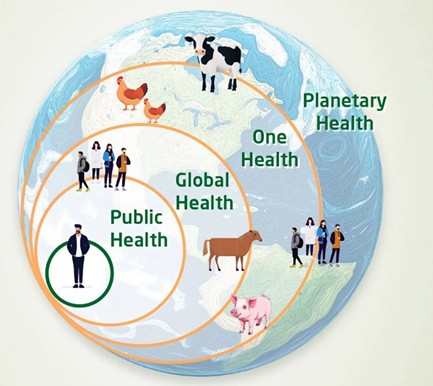
Infographic of the Planetary Health concept (BIOFACH,2025)
Forests, SDGs and justice
In conclusion, healthy forests support Sustainable Development Goal (SDG) 15, which focuses on land. But forests are also vital for achieving other SDGs, so when forests are degraded, it becomes more difficult for communities to maintain stable livelihoods. Therefore, planetary health encourages us to see forests not just as financial resources but also as life-supporting systems whose preservation is less costly and more compassionate than paying for their eventual destruction. Understanding this connection shifts my perspective on "development"; in my view, true progress should involve making immediate investments in biodiversity restoration, forest conservation, and climate stability so that both present and future generations can lead healthy, respectful lives.
References
Partners, C. I. (2024, November 28). The effects of deforestation. Climate Impact Partners. https://www.climateimpact.com/news-insights/insights/effects-of-deforestation/
Biodiversity. (2024, November 7). https://www.who.int/teams/environment-climate-change-and-health/climate-change-and-health/biodiversity
Admin. (2021, June 30). The UN SDGs on Biodiversity, Climate Change and Health: Towards a Shared Agenda | UCL Faculty of Social & Historical Sciences. UCL Faculty of Social & Historical Sciences. https://www.ucl.ac.uk/social-historical-sciences/news/2021/jun/un-sdgs-biodiversity-climate-change-and-health-towards-shared-agenda
Halonen, J. I., Erhola, M., Furman, E., Haahtela, T., Jousilahti, P., Barouki, R., Bergman, Å., Billo, N. E., Fuller, R., Haines, A., Kogevinas, M., Kolossa-Gehring, M., Krauze, K., Lanki, T., Vicente, J. L., Messerli, P., Nieuwenhuijsen, M., Paloniemi, R., Peters, A., . . . Antó, J. M. (2020). A call for urgent action to safeguard our planet and our health in line with the helsinki declaration. Environmental Research, 193, 110600. https://doi.org/10.1016/j.envres.2020.110600
Losing forest carbon stocks could put climate goals out of reach. (2025, March 25). ScienceDaily. https://www.sciencedaily.com/releases/2025/03/250327141738.htm
Mago, A., Dhali, A., Kumar, H., Maity, R., & Kumar, B. (2024). Planetary health and its relevance in the modern era: A topical review. SAGE Open Medicine, 12, 20503121241254231. https://doi.org/10.1177/20503121241254231
Perilli, A., Adduci, A., Ricciardi, W., De Belvis, A. G., & Cadeddu, C. (2024). Towards planetary health systems: a manifesto for a revised quadruple aim for healthcare improvement. Global Sustainability, 7. https://doi.org/10.1017/sus.2024.39
