
The Pulse of Planetary Health: The Roots of Resilience
Introduction
In the current Anthropocene era, the complex relationship between forests and human survival is more important than ever. It is becoming increasingly clear as we navigate the complex terrain of the Sustainable Development Goals (SDGs) that forests are the cornerstone of "Planetary Health" rather than just a setting for biodiversity. The conflict between forest extraction and conservation is examined in this reply paper, which also considers how we manage these ecosystems will determine the stability of the world in the future.
In the current Anthropocene era, the complex relationship between forests and human survival is more important than ever. It is becoming increasingly clear as we navigate the complex terrain of the Sustainable Development Goals (SDGs) that forests are the cornerstone of "Planetary Health" rather than just a setting for biodiversity. The conflict between forest extraction and conservation is examined in this reply paper, which also considers how we manage these ecosystems will determine the stability of the world in the future.
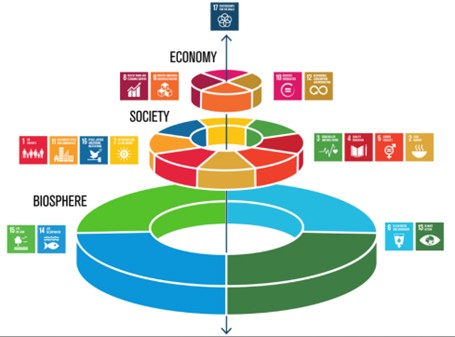
Figure 1. The SDG Wedding Cake model illustrates the biosphere as the foundation for society and the economy. Source Azote for Stockholm Resilience Centre (2016).
Forests as the Foundation of the SDGs
Forests are the biological infrastructure that supports several SDGs; they are not separate ecosystems. The benefits of healthy forests go far beyond the obvious focus of Goal 15 (Life on Land) on forest management. For example, as the planet's main terrestrial carbon sinks, forests are essential to achieving Goal 13 (Climate Action) and Goal 6 (Clean Water and Sanitation) by acting as natural filtration systems.
Crucially, traditional forestry often fails to connect to Goal 3 (Good Health and Well-Being). According to the "Planetary Health" approach, reducing the availability of medicinal resources and increasing the likelihood of zoonotic disease spillover are two consequences of degrading forest integrity.
Forests are the biological infrastructure that supports several SDGs; they are not separate ecosystems. The benefits of healthy forests go far beyond the obvious focus of Goal 15 (Life on Land) on forest management. For example, as the planet's main terrestrial carbon sinks, forests are essential to achieving Goal 13 (Climate Action) and Goal 6 (Clean Water and Sanitation) by acting as natural filtration systems.
Crucially, traditional forestry often fails to connect to Goal 3 (Good Health and Well-Being). According to the "Planetary Health" approach, reducing the availability of medicinal resources and increasing the likelihood of zoonotic disease spillover are two consequences of degrading forest integrity.
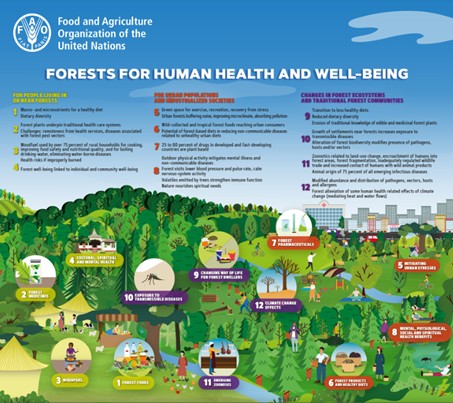
Figure 2: Infographic showcasing the diverse health benefits provided by forest ecosystems. Source FAO (2020)
Handling the Delicate Divide: Environmentalist vs. Forester
The historical conflict between the "Forester" and the "Environmentalist" is a particularly delicate subject in this sector. Foresters were traditionally seen as extraction managers who prioritised economic efficiency and yield. On the other hand, environmentalists were perceived as preservationists who saw human interference as dangerous.
This dichotomy is becoming more antiquated and ineffective in the twenty-first century. We need to integrate these positions to achieve the SDGs. To maintain biodiversity, sustainable forest management requires both the technical know-how of the forester to ensure resource availability and the ethical and ecological vision of the environmentalist. Economic pressures are often the source of this discussion's sensitivity, yet genuine planetary health requires that economic gain not come at the expense of ecological collapse.
The Difficulties of Global Implementation
Although the SDGs offer a global vision, competing national interests often conflict with the realities of international forestry. Despite being the main consumers of goods that cause deforestation, high-income countries often advocate conservation in the Global South. This "reaction" calls for a change in global accountability rather than only policy.
We need to shift to a model where "success" is determined by the resilience of the forest-human connection rather than by GDP or timber export numbers alone. This entails defending indigenous peoples' land rights and ensuring that local communities, who are often the best land managers, directly benefit from conservation initiatives.
Conclusion
Reflecting on the theme of "Forests, SDGs, and Planetary Health", it is evident that our approach to forestry must become more holistic. We cannot treat the environment as a separate entity from human society. As we face an escalating climate crisis, the forests stand as our most effective tool for mitigation and adaptation. The future of forestry lies in recognising that every tree planted or protected is a direct investment in the health of the human species.
References
Food and Agriculture Organization of the United Nations. (2022). The State of the World’s Forests 2022: Forest pathways for green recovery. FAO.
Myers, S. S., & Frumkin, H. (2020). Planetary Health: Protecting Nature to Protect Ourselves. Island Press
United Nations. (2015). Transforming our world: The 2030 Agenda for Sustainable Development. UN Publishing.
Whitmee, S., et al. (2015). Safeguarding human health in the Anthropocene epoch: Report of the Rockefeller Foundation–Lancet Commission on planetary health. The Lancet, 386(10007), 1973-2028.
Sayer, J., & Maginnis, S. (2015). Forests in Landscapes: Ecosystem Approaches to Conservation and Development. Routledge.
World Bank. (2023). Forests, Climate Change, and Biodiversity: A Strategy for Sustainable Development. World Bank Publications.
