

While the World Talks Green, Aceh Bleeds Green
Introduction
Forests worldwide now stand at a crossroads. From the Amazon to Borneo, biodiversity loss, climate instability, and land-use pressure are converging at unprecedented speed. International Environment Day often reminds us of the importance of forests as global carbon sinks, wildlife habitats, cultural resources, and climate regulators. Still, the reality on the ground shows that many ecosystems are degrading faster than they can recover. Deforestation in the tropics alone accounted for millions of hectares of loss in the past decade, with cascading consequences for species extinction, hydrological disruption, and community well-being (Lewis et al., 2019). Southeast Asia remains critical due to its dense biodiversity, rapid land-use change, and complex socio-political landscape.
Aceh is a revealing case study. Its forests still hold incredible ecological value, yet face acute pressure from development and governance challenges. What is happening in Aceh mirrors global tensions between conservation ambition and economic demand, between community rights and external interests, and between restoration rhetoric and actual outcomes.
Forests worldwide now stand at a crossroads. From the Amazon to Borneo, biodiversity loss, climate instability, and land-use pressure are converging at unprecedented speed. International Environment Day often reminds us of the importance of forests as global carbon sinks, wildlife habitats, cultural resources, and climate regulators. Still, the reality on the ground shows that many ecosystems are degrading faster than they can recover. Deforestation in the tropics alone accounted for millions of hectares of loss in the past decade, with cascading consequences for species extinction, hydrological disruption, and community well-being (Lewis et al., 2019). Southeast Asia remains critical due to its dense biodiversity, rapid land-use change, and complex socio-political landscape.
Aceh is a revealing case study. Its forests still hold incredible ecological value, yet face acute pressure from development and governance challenges. What is happening in Aceh mirrors global tensions between conservation ambition and economic demand, between community rights and external interests, and between restoration rhetoric and actual outcomes.
Aceh’s Forests: Climate Regulators and Biodiversity Refuges
Aceh hosts part of the Leuser and Ulu Masen ecosystems, two of the last strongholds for critically endangered species such as the Sumatran tiger, elephant, and orangutan. These intact tropical forests regulate carbon, stabilise water cycles, and support ecological resilience. Protecting remaining primary forests provides the highest climate and biodiversity benefits, far surpassing the carbon storage potential of plantations or newly planted forests (Lewis et al., 2019). Aceh’s forests represent both a local and global environmental asset.
Recent Deforestation Trends
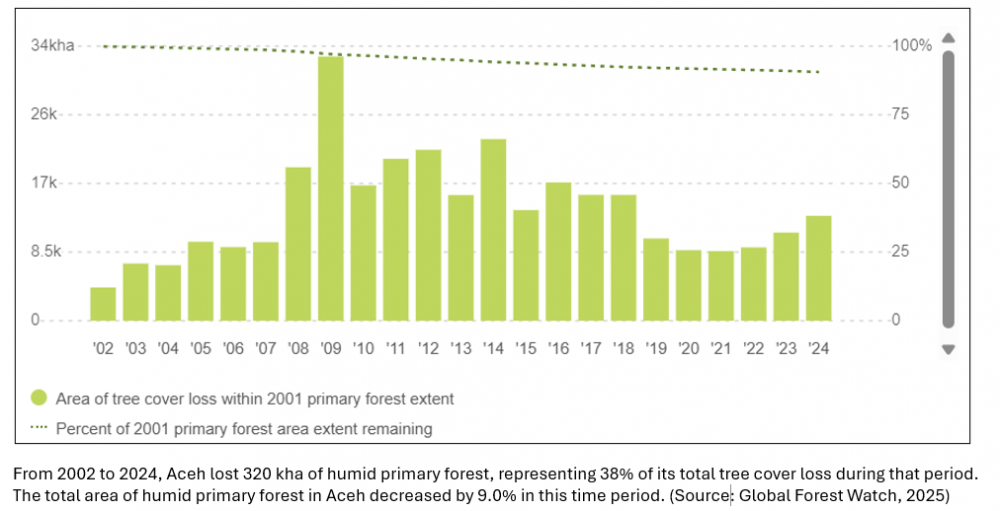
Despite their importance, Aceh’s forests are shrinking. Monitoring by HAkA (2024) recorded approximately 8,900 ha of forest loss in 2023 due to plantation expansion, encroachment, and road development. Southeast Asia continues to experience some of the world’s highest primary forest loss, especially in Indonesia’s fire-prone and plantation-dominated landscapes (WRI, 2025; Mongabay, 2024). Such losses open wildlife corridors to poaching, degrade ecosystem integrity, and increase vulnerability to floods and landslides (Lubis et al., 2024).
From Tree Planting to True Ecological Restoration
Tree-planting campaigns often overshadow deeper ecological needs. While planting draws attention, it rarely addresses land tenure, species diversity, soil condition, or environmental function. Successful forest recovery depends on restoring ecological processes, including hydrology, natural regeneration, and species interactions (Lee et al., 2019). In Aceh, this means prioritising protection of intact forests first, then restoring degraded corridors through science-based methods rather than politically popular quick fixes.
Community Stewardship and Ecotourism
Local communities in Aceh have historically played a significant role in forest protection. Evidence from community patrols and participatory monitoring shows reductions in illegal activities where communities are empowered (HAkA, 2024). Ecotourism initiatives offer alternative income pathways, but only when benefit-sharing is fair, ecological limits are respected, and governance is transparent. Genuine expectation is to give communities authority and resources to steward forests.
Mangroves: Aceh’s Coastal Shield
Aceh’s mangrove areas provide significant climate-resilience benefits. Mangroves store up to four times more carbon per hectare than terrestrial forests and protect coastal communities from surges and erosion (Global Mangrove Alliance, 2021). Yet nearly half of the world’s mangroves are under threat (Reuters, 2024). Aceh’s restoration efforts show promise, but planting alone is not enough unless hydrology, sediment flow, and community livelihoods are aligned with long-term conservation goals (Lee et al., 2019; Global Mangrove Alliance, 2021).
Looking Forward
For Aceh and similar tropical landscapes, expectations must move beyond symbolic commitments. Effective forest and biodiversity protection requires protecting remaining primary forests and wildlife corridors, shifting restoration toward ecological function, centring community participation, and treating mangroves as climate infrastructure. Aceh’s story shows that forests can still recover if actions match the urgency of the moment.
References
Global Mangrove Alliance. (2021). The State of the World’s Mangroves 2021. https://www.mangrovealliance.org/mangrove-forests
HAkA. (2024, July 16). HAkA: Aceh loses 8,906 hectares of forest cover in one year. https://haka.or.id/en/haka-aceh-loses-8906-hectares-of-forest-cover-in-one-year-2/
Lee, S. Y., Hamilton, S., Barbier, E. B., Primavera, J., & Lewis, R. R. (2019). Better restoration policies are needed to conserve mangrove ecosystems. Nature Ecology & Evolution, 3(6), 870–872. https://doi.org/10.1038/s41559-019-0861-y
Lewis, S. L., Wheeler, C. E., Mitchard, E. T. A., & Koch, A. (2019). Regenerate natural forests to store carbon. Nature, 568(7750), 25–28. https://doi.org/10.1038/d41586-019-01026-8
Lubis, M. I., et al. (2024). Tropical forest cover, oil palm plantations, and precipitation: Flood occurrences in Aceh. PLOS ONE. https://doi.org/10.1371/journal.pone.0311759
Mongabay. (2024, March 14). Palm oil deforestation persists in Indonesia's Leuser amid new mills, plantations.
https://news.mongabay.com/2024/03/palm-oil-deforestation-persists-in-indonesias-leuser-amid-new-mills-plantations/
Reuters. (2024, May 23). Half of world’s mangroves under threat, says conservation group. https://www.reuters.com/business/environment/half-worlds-mangroves-under-threat-says-conservation-group-2024-05-23/
WRI – Global Forest Review. (2025, May 21). Fires drove record-breaking tropical forest loss in 2024. https://gfr.wri.org/latest-analysis-deforestation-trends
Aceh hosts part of the Leuser and Ulu Masen ecosystems, two of the last strongholds for critically endangered species such as the Sumatran tiger, elephant, and orangutan. These intact tropical forests regulate carbon, stabilise water cycles, and support ecological resilience. Protecting remaining primary forests provides the highest climate and biodiversity benefits, far surpassing the carbon storage potential of plantations or newly planted forests (Lewis et al., 2019). Aceh’s forests represent both a local and global environmental asset.
Recent Deforestation Trends
Despite their importance, Aceh’s forests are shrinking. Monitoring by HAkA (2024) recorded approximately 8,900 ha of forest loss in 2023 due to plantation expansion, encroachment, and road development. Southeast Asia continues to experience some of the world’s highest primary forest loss, especially in Indonesia’s fire-prone and plantation-dominated landscapes (WRI, 2025; Mongabay, 2024). Such losses open wildlife corridors to poaching, degrade ecosystem integrity, and increase vulnerability to floods and landslides (Lubis et al., 2024).
From Tree Planting to True Ecological Restoration
Tree-planting campaigns often overshadow deeper ecological needs. While planting draws attention, it rarely addresses land tenure, species diversity, soil condition, or environmental function. Successful forest recovery depends on restoring ecological processes, including hydrology, natural regeneration, and species interactions (Lee et al., 2019). In Aceh, this means prioritising protection of intact forests first, then restoring degraded corridors through science-based methods rather than politically popular quick fixes.
Community Stewardship and Ecotourism
Local communities in Aceh have historically played a significant role in forest protection. Evidence from community patrols and participatory monitoring shows reductions in illegal activities where communities are empowered (HAkA, 2024). Ecotourism initiatives offer alternative income pathways, but only when benefit-sharing is fair, ecological limits are respected, and governance is transparent. Genuine expectation is to give communities authority and resources to steward forests.
Mangroves: Aceh’s Coastal Shield
Aceh’s mangrove areas provide significant climate-resilience benefits. Mangroves store up to four times more carbon per hectare than terrestrial forests and protect coastal communities from surges and erosion (Global Mangrove Alliance, 2021). Yet nearly half of the world’s mangroves are under threat (Reuters, 2024). Aceh’s restoration efforts show promise, but planting alone is not enough unless hydrology, sediment flow, and community livelihoods are aligned with long-term conservation goals (Lee et al., 2019; Global Mangrove Alliance, 2021).
Looking Forward
For Aceh and similar tropical landscapes, expectations must move beyond symbolic commitments. Effective forest and biodiversity protection requires protecting remaining primary forests and wildlife corridors, shifting restoration toward ecological function, centring community participation, and treating mangroves as climate infrastructure. Aceh’s story shows that forests can still recover if actions match the urgency of the moment.
References
Global Mangrove Alliance. (2021). The State of the World’s Mangroves 2021. https://www.mangrovealliance.org/mangrove-forests
HAkA. (2024, July 16). HAkA: Aceh loses 8,906 hectares of forest cover in one year. https://haka.or.id/en/haka-aceh-loses-8906-hectares-of-forest-cover-in-one-year-2/
Lee, S. Y., Hamilton, S., Barbier, E. B., Primavera, J., & Lewis, R. R. (2019). Better restoration policies are needed to conserve mangrove ecosystems. Nature Ecology & Evolution, 3(6), 870–872. https://doi.org/10.1038/s41559-019-0861-y
Lewis, S. L., Wheeler, C. E., Mitchard, E. T. A., & Koch, A. (2019). Regenerate natural forests to store carbon. Nature, 568(7750), 25–28. https://doi.org/10.1038/d41586-019-01026-8
Lubis, M. I., et al. (2024). Tropical forest cover, oil palm plantations, and precipitation: Flood occurrences in Aceh. PLOS ONE. https://doi.org/10.1371/journal.pone.0311759
Mongabay. (2024, March 14). Palm oil deforestation persists in Indonesia's Leuser amid new mills, plantations.
https://news.mongabay.com/2024/03/palm-oil-deforestation-persists-in-indonesias-leuser-amid-new-mills-plantations/
Reuters. (2024, May 23). Half of world’s mangroves under threat, says conservation group. https://www.reuters.com/business/environment/half-worlds-mangroves-under-threat-says-conservation-group-2024-05-23/
WRI – Global Forest Review. (2025, May 21). Fires drove record-breaking tropical forest loss in 2024. https://gfr.wri.org/latest-analysis-deforestation-trends
