

Mangrove’s Last Stand: Future-Proofing Our Coastal Zones
Introduction
On International Environmental Day, as we reflect on global environmental progress, the silence of Southeast Asia’s vanishing mangrove forests should be the loudest warning siren. We acknowledge these ecosystems as vital natural coastal defences and unparalleled flaws in our priorities. Are we, as custodians of the world’s most diverse mangrove ecosystems, truly learning the lessons of environmental economics, or are we simply repeating the mistakes of short-sighted land use?
When faced with escalating climate threats, from intensifying storm surges to inexorable sea-level rise, the question that came to our minds was: why do we still authorise the conversion of these natural shields into unsustainable aquaculture ponds, despite the clear scientific evidence of their protective capacity (Barbier et al., 2011)? If a single hectare of mangrove can store significantly more carbon than its terrestrial counterpart, why do policy frameworks often fail to integrate mangrove conservation into national climate mitigation targets? Therefore, the question that has been playing on everyone's minds is the underlying political and economic drivers of mangrove degradation, and it proposes that achieving true coastal resilience requires an immediate, paradigm-shifting investment in holistic conservation, moving far beyond symbolic tree-planting initiatives.
On International Environmental Day, as we reflect on global environmental progress, the silence of Southeast Asia’s vanishing mangrove forests should be the loudest warning siren. We acknowledge these ecosystems as vital natural coastal defences and unparalleled flaws in our priorities. Are we, as custodians of the world’s most diverse mangrove ecosystems, truly learning the lessons of environmental economics, or are we simply repeating the mistakes of short-sighted land use?
When faced with escalating climate threats, from intensifying storm surges to inexorable sea-level rise, the question that came to our minds was: why do we still authorise the conversion of these natural shields into unsustainable aquaculture ponds, despite the clear scientific evidence of their protective capacity (Barbier et al., 2011)? If a single hectare of mangrove can store significantly more carbon than its terrestrial counterpart, why do policy frameworks often fail to integrate mangrove conservation into national climate mitigation targets? Therefore, the question that has been playing on everyone's minds is the underlying political and economic drivers of mangrove degradation, and it proposes that achieving true coastal resilience requires an immediate, paradigm-shifting investment in holistic conservation, moving far beyond symbolic tree-planting initiatives.
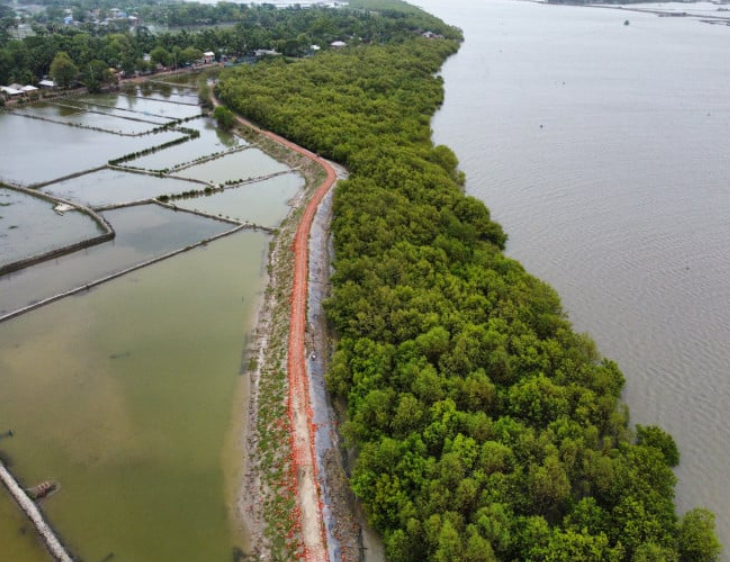
Mangroves aerial view
What We Learn?: the Dual Crisis of Valuation and Loss
The first crucial lesson we learn is the massive ecological and climate consequences of mismanaging this critical interface between land and sea. Academically, mangroves are recognised for their outsized role in climate regulation; studies in Indonesia, which holds 24% of the world’s mangroves, highlight that their carbon stocks are among the highest of any tropical forest type (Arifanti et al., 2022). What is often missed, however, is the catastrophic flip side: when a mangrove forest is cleared, particularly for shrimp and fish farming, the centuries of stored carbon are oxidised, releasing significant greenhouse gases that far exceed the emissions from upland tropical deforestation (Friess et al., 2020). This creates a dual crisis: a loss of carbon sink and the creation of a massive carbon source.
The primary driver of this loss across the region, from the Mekong Delta to the Straits of Malacca, remains the rapid expansion of short-term, profit-driven ventures such as aquaculture and agriculture (Richards & Friess, 2015). This pattern reveals a failure in valuation. We have prioritised immediate economic gain—a temporary boost in shrimp exports over the immense, long-term, and irreplaceable ecosystem services provided by intact mangroves: coastal stabilisation, nursery habitat for fisheries, and storm protection. This undervaluation represents a profound failure of governance and resource management. We have learned that without robust economic incentives that recognise the "blue carbon" value, forests will continue to fall to the most financially competitive land use.
What we expect: Governance and the Future of Restoration
Our expectations for future environmental governance must be radical and ecosystem-centric. We cannot afford the fragmented approach that often leaves mangroves in policy gaps between marine protection laws and terrestrial forestry acts (King et al., 2024). Instead, we must expect and demand three major shifts:
First, a shift from simple planting to authentic ecological restoration. The lessons from numerous failed mangrove projects worldwide are clear: merely planting seedlings in an unsuitable area often results in a half-failure rate. Authentic restoration, as advocated by experts, requires the initial identification and rectification of the underlying hydrological issues (Lopez-Portillo et al., 2017). If the tidal flow has been blocked by abandoned shrimp ponds or coastal infrastructure, planting is futile. Therefore, we expect national agencies to adopt science-based Best Practice Guidelines focused on restoring tidal connections first, allowing natural recolonisation to follow.
Secondly, a stronger integration of community-based management. The future of mangrove conservation hinges on empowering the local communities who depend on these forests for their livelihoods (Gevaña et al., 2018). Traditional, government-centred management approaches have proven ineffective against decentralised, market-driven threats like illegal logging and encroachment. By clarifying tenure rights and establishing fair Payment for Ecosystem Services (PES) schemes, we can turn local fishers and residents into effective forest guardians. This collaborative model ensures conservation efforts are effective, equitable, and sustainable, directly connecting human well-being to ecosystem health.
Finally, we expect the full mobilisation of Blue Carbon finance. With global interest in climate solutions growing, the high carbon density of mangroves must be leveraged to attract investment. After reading the article by Mohan (2023), National commitments (NDCs) under the Paris Agreement should include specific, verifiable targets for avoided mangrove loss and restoration, thereby creating a robust framework for carbon credit trading that generates long-term funding for protection and enforcement. This financial mechanism is the only way to offset the economic pressure from competing industries.
Conclusion
On the International Environment Day, what do we learn, what do we expect? Presents a clear challenge regarding mangroves. We have learned that these are not merely trees, but the ultimate natural infrastructure, acting as carbon sinks and shields against climate catastrophe. We have also learned that current policy and market forces are failing them. Our expectation for the future must therefore be a unified, science-driven strategy: moving beyond tokenistic tree planting to hydrological restoration; empowering communities as primary managers; and leveraging the high value of Blue Carbon to fund their protection. Will we rise to the challenge and fortify these coastal zones for the future, or will we watch the last stand of our mangroves crumble, taking our coastal resilience with them? The answer lies in the courage of our political commitments and the immediate scale of our investment.
References
Arifanti, V.B., Kauffman, J. B., Subarno, Ilman, M., Tosiani, A., and Novita, N.,(2022), Contributions of Mangrove Conservation and Restoration to Climate Change Mitigation in Indonesia, Global Change Biology, 28(15), 4523-4538. https://doi.org/10.1111/gcb.16216
Barbier, E. B., Hacker, S.D., Kennedy, C., Koch, E.W., Stier, A.C, and Silliman, B. R, (2011), The Value of Estuarine and Coastal Ecosystem Services, The Ecological Society of America, 81(2), 169-193. https://doi.org/10.1890/10-1510.1
Friess, D.A., Krauss, K.W., Taillardat, P., Adame, M.F., Yando, e.S., Cameron, C., Sasmito, S.D., & Sillanpaa, M., (2020), Mangrove Blue Carbon in the Face of Deforestation, Climate Change, and Restoration, Griffith University, 3(3), 427-456, https://doi.org/10.1002/9781119312994.apr0752
Gevana, D.T., Camacho, L. D., & Pulhin, J.M., (2018), Conserving Mangroves for Their Blue Carbon: Insights and Prospects for Community-Based Mangroves Management in Southeast Asia, Springer, Cham, 579-588. https://doi.org/10.1007/978-3-319-73016-5_26
King, D., Lewin, A., Mawson, R., McKay, P., James, R., and Wang., Y., (2024), Addressing the Policy Gaps and Challenges to Originating High-Quality Blue Carbon Projects in the Asia Pacific Region, A Systematic Evidence Synthesis Bolstered by Practitioner Consultation, Preprintrs.org, https://doi.org/10.20944/preprints202407.1529.v1
Lopez-Portillo, J., Lewis, R.R., Saenger, P., Rovai, A., Koedam, N., Dahdouh-Guebas, F., Agraz-Hernandez, C., and Rivera-Monroy, V.H.,(2017), Mangrove Ecosystems: Global Biogeographic Perspective, Springer,Cham, 310-345, https://doi.org/10.1007/978-3-319-62206-4_10
Mohan, P. S., (2023), Implementing Nationally Determined Contributions Under the Paris Agreement: An Assessment of Ocean-Based Climate Action in Caribbean Small Island Developing States, Elsevier, 155. https://doi.org/10.1016/j.marpol.2023.105787
Richards, D.A., and Friess, D.A. (2015), Rates and Drivers of Mangrove Deforestation in Southeast Asia 2000-2012, Proceedings of the National Academy of Sciences of the United States of America (PNAS), 113(2), 344-349. https://doi.org/10.1073/pnas.1510272113
The first crucial lesson we learn is the massive ecological and climate consequences of mismanaging this critical interface between land and sea. Academically, mangroves are recognised for their outsized role in climate regulation; studies in Indonesia, which holds 24% of the world’s mangroves, highlight that their carbon stocks are among the highest of any tropical forest type (Arifanti et al., 2022). What is often missed, however, is the catastrophic flip side: when a mangrove forest is cleared, particularly for shrimp and fish farming, the centuries of stored carbon are oxidised, releasing significant greenhouse gases that far exceed the emissions from upland tropical deforestation (Friess et al., 2020). This creates a dual crisis: a loss of carbon sink and the creation of a massive carbon source.
The primary driver of this loss across the region, from the Mekong Delta to the Straits of Malacca, remains the rapid expansion of short-term, profit-driven ventures such as aquaculture and agriculture (Richards & Friess, 2015). This pattern reveals a failure in valuation. We have prioritised immediate economic gain—a temporary boost in shrimp exports over the immense, long-term, and irreplaceable ecosystem services provided by intact mangroves: coastal stabilisation, nursery habitat for fisheries, and storm protection. This undervaluation represents a profound failure of governance and resource management. We have learned that without robust economic incentives that recognise the "blue carbon" value, forests will continue to fall to the most financially competitive land use.
What we expect: Governance and the Future of Restoration
Our expectations for future environmental governance must be radical and ecosystem-centric. We cannot afford the fragmented approach that often leaves mangroves in policy gaps between marine protection laws and terrestrial forestry acts (King et al., 2024). Instead, we must expect and demand three major shifts:
First, a shift from simple planting to authentic ecological restoration. The lessons from numerous failed mangrove projects worldwide are clear: merely planting seedlings in an unsuitable area often results in a half-failure rate. Authentic restoration, as advocated by experts, requires the initial identification and rectification of the underlying hydrological issues (Lopez-Portillo et al., 2017). If the tidal flow has been blocked by abandoned shrimp ponds or coastal infrastructure, planting is futile. Therefore, we expect national agencies to adopt science-based Best Practice Guidelines focused on restoring tidal connections first, allowing natural recolonisation to follow.
Secondly, a stronger integration of community-based management. The future of mangrove conservation hinges on empowering the local communities who depend on these forests for their livelihoods (Gevaña et al., 2018). Traditional, government-centred management approaches have proven ineffective against decentralised, market-driven threats like illegal logging and encroachment. By clarifying tenure rights and establishing fair Payment for Ecosystem Services (PES) schemes, we can turn local fishers and residents into effective forest guardians. This collaborative model ensures conservation efforts are effective, equitable, and sustainable, directly connecting human well-being to ecosystem health.
Finally, we expect the full mobilisation of Blue Carbon finance. With global interest in climate solutions growing, the high carbon density of mangroves must be leveraged to attract investment. After reading the article by Mohan (2023), National commitments (NDCs) under the Paris Agreement should include specific, verifiable targets for avoided mangrove loss and restoration, thereby creating a robust framework for carbon credit trading that generates long-term funding for protection and enforcement. This financial mechanism is the only way to offset the economic pressure from competing industries.
Conclusion
On the International Environment Day, what do we learn, what do we expect? Presents a clear challenge regarding mangroves. We have learned that these are not merely trees, but the ultimate natural infrastructure, acting as carbon sinks and shields against climate catastrophe. We have also learned that current policy and market forces are failing them. Our expectation for the future must therefore be a unified, science-driven strategy: moving beyond tokenistic tree planting to hydrological restoration; empowering communities as primary managers; and leveraging the high value of Blue Carbon to fund their protection. Will we rise to the challenge and fortify these coastal zones for the future, or will we watch the last stand of our mangroves crumble, taking our coastal resilience with them? The answer lies in the courage of our political commitments and the immediate scale of our investment.
References
Arifanti, V.B., Kauffman, J. B., Subarno, Ilman, M., Tosiani, A., and Novita, N.,(2022), Contributions of Mangrove Conservation and Restoration to Climate Change Mitigation in Indonesia, Global Change Biology, 28(15), 4523-4538. https://doi.org/10.1111/gcb.16216
Barbier, E. B., Hacker, S.D., Kennedy, C., Koch, E.W., Stier, A.C, and Silliman, B. R, (2011), The Value of Estuarine and Coastal Ecosystem Services, The Ecological Society of America, 81(2), 169-193. https://doi.org/10.1890/10-1510.1
Friess, D.A., Krauss, K.W., Taillardat, P., Adame, M.F., Yando, e.S., Cameron, C., Sasmito, S.D., & Sillanpaa, M., (2020), Mangrove Blue Carbon in the Face of Deforestation, Climate Change, and Restoration, Griffith University, 3(3), 427-456, https://doi.org/10.1002/9781119312994.apr0752
Gevana, D.T., Camacho, L. D., & Pulhin, J.M., (2018), Conserving Mangroves for Their Blue Carbon: Insights and Prospects for Community-Based Mangroves Management in Southeast Asia, Springer, Cham, 579-588. https://doi.org/10.1007/978-3-319-73016-5_26
King, D., Lewin, A., Mawson, R., McKay, P., James, R., and Wang., Y., (2024), Addressing the Policy Gaps and Challenges to Originating High-Quality Blue Carbon Projects in the Asia Pacific Region, A Systematic Evidence Synthesis Bolstered by Practitioner Consultation, Preprintrs.org, https://doi.org/10.20944/preprints202407.1529.v1
Lopez-Portillo, J., Lewis, R.R., Saenger, P., Rovai, A., Koedam, N., Dahdouh-Guebas, F., Agraz-Hernandez, C., and Rivera-Monroy, V.H.,(2017), Mangrove Ecosystems: Global Biogeographic Perspective, Springer,Cham, 310-345, https://doi.org/10.1007/978-3-319-62206-4_10
Mohan, P. S., (2023), Implementing Nationally Determined Contributions Under the Paris Agreement: An Assessment of Ocean-Based Climate Action in Caribbean Small Island Developing States, Elsevier, 155. https://doi.org/10.1016/j.marpol.2023.105787
Richards, D.A., and Friess, D.A. (2015), Rates and Drivers of Mangrove Deforestation in Southeast Asia 2000-2012, Proceedings of the National Academy of Sciences of the United States of America (PNAS), 113(2), 344-349. https://doi.org/10.1073/pnas.1510272113
