Reforestation as a Saviour Against Climate Catastrophe
Introduction
As the planet faces rising temperatures, extreme weather, and ecological collapse, forests are no longer just natural wonders — they are essential allies in securing a livable future (UNDP, 2023). Covering approximately 31% of Earth’s land surface, forests are aptly called the “lungs of the planet.” They absorb carbon dioxide, release oxygen, and provide shelter for over 80% of terrestrial species (IUCN, 2021).
Yet, widespread deforestation and forest degradation continue to threaten biodiversity and destabilise the global climate. As the crisis deepens, scientists and policymakers are urgently seeking scalable solutions to reduce emissions and restore ecological balance. One of the most promising strategies is reforestation — the process of planting trees to restore or replenish lost or damaged forests. Celebrated as a natural climate solution, reforestation has the potential to sequester carbon, rebuild ecosystems, and support sustainable livelihoods. But can this nature-based approach truly help us avert climate catastrophe?
The Science Behind Reforestation
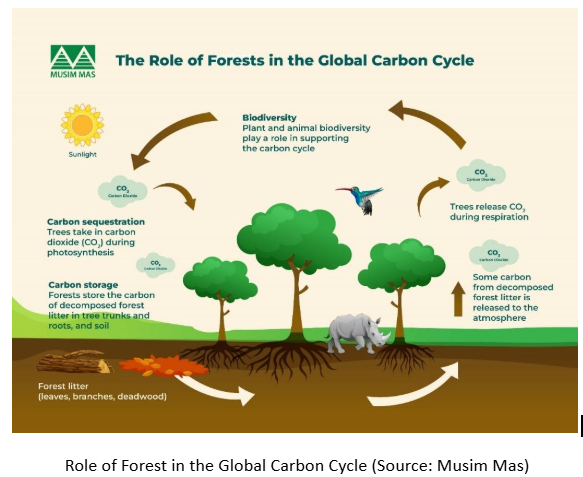
Reforestation plays a vital role in climate mitigation by harnessing the natural power of trees. Through photosynthesis, trees absorb carbon dioxide (CO₂) from the atmosphere and store it in their biomass — a process known as carbon sequestration (Psistaki et al., 2024). This makes forests one of the most effective and affordable tools for reducing greenhouse gas emissions. The carbon absorption capacity of a tree depends on its species, age, and growing conditions. On average, a mature tree can absorb approximately 48 pounds (22 kg) of CO₂ per year. Over its lifetime, a single tree can sequester a ton or more of carbon dioxide (IERE Team, 2025).
According to the International Union for Conservation of Nature (IUCN), halting deforestation and restoring degraded forests could deliver over one-third of the climate change mitigation needed by 2030. Similarly, the Intergovernmental Panel on Climate Change (IPCC) reports that the agriculture, forestry, and other land use (AFOLU) sector could contribute up to 30% of the emissions reductions required to limit global warming to 2°C, at relatively low cost (IPCC, 2022).
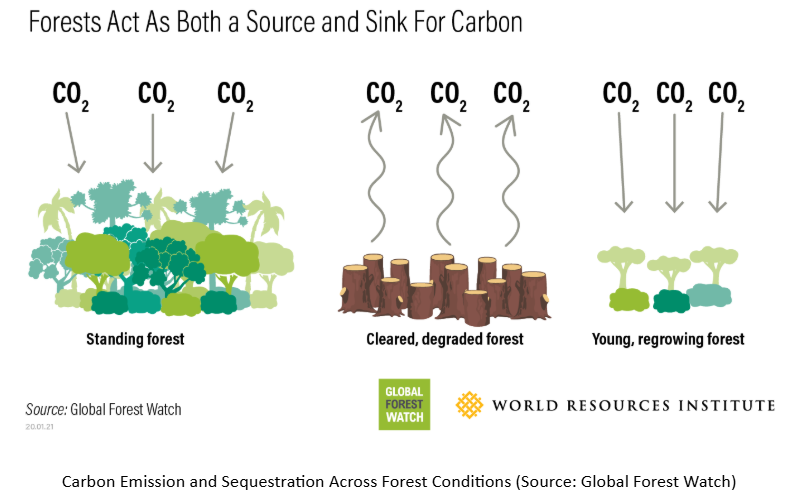
However, when forests are cleared or burned, the carbon they have stored over decades is released back into the atmosphere, significantly accelerating climate change. Recent data reveal that global forests emit an average of 8.1 billion metric tonnes of carbon dioxide annually due to deforestation and related disturbances, while absorbing around 16 billion metric tonnes each year (World Resources Institute, 2021). This imbalance highlights a troubling feedback loop: deforestation not only adds CO₂ to the atmosphere but also weakens the Earth’s natural ability to remove it, compounding the climate crisis (IERE Team, 2025).
Global Calls to Action
Recognising the immense potential of forests to combat climate change, countries and organisations worldwide are stepping up their commitments to reforestation and forest protection. The Bonn Challenge, launched in 2011, aims to restore 350 million hectares of degraded land by 2030 — a goal supported by over 60 nations (IUCN, 2018). Similarly, the UN Decade on Ecosystem Restoration (2021–2030) calls for coordinated global efforts to revive ecosystems, with forests at the heart of this mission. Major economies, such as China, India, and Brazil, have launched large-scale tree-planting campaigns, while regional initiatives, including Africa’s Great Green Wall, aim to combat desertification and restore biodiversity across the Sahel (UNEP, 2023). These efforts demonstrate that reforestation is not just a local solution but a global imperative.
Conclusion
Forests are our frontline defence against climate change, but they are under threat. Reforestation offers a hopeful path forward — one that restores ecosystems, absorbs carbon, and supports communities. While it’s not a standalone solution, it is a vital piece of the climate puzzle. With science, policy, and public support aligned, reforestation can help breathe new life into the planet—and secure a sustainable future for generations to come.
References
Psistaki, K., Tsantopoulos, G., & Paschalidou, A. K. (2024). An Overview of the Role of Forests in Climate Change Mitigation. Sustainability, 16(14), 6089–6089. https://doi.org/10.3390/su16146089
IERE Team. (2025, June 2). How can reforestation help climate change? The Institute for Environmental Research and Education (IERE). Retrieved October 20, 2025, from https://iere.org/how-can-reforestation-help-climate-change/
International Union for Conservation of Nature (IUCN). (2021, February). Forests and climate change. Retrieved October 20, 2025, from https://iucn.org/resources/issues-brief/forests-and-climate-change
IUCN. (2018). Bonn Challenge and India. International Union for Conservation of Nature. https://doi.org/10.2305/IUCN.CH.2018.12.en
Intergovernmental Panel on Climate Change. (2022). Chapter 7: Agriculture, forestry, and other land uses (AFOLU). In Climate Change 2022: Mitigation of Climate Change. Working Group III contribution to the Sixth Assessment Report of the Intergovernmental Panel on Climate Change. https://www.ipcc.ch/report/ar6/wg3/chapter/chapter-7/
UNDP. (2023, October 25). Forests can help us limit climate change – here is how. UNDP Climate Promise. Retrieved October 20, 2025, from https://climatepromise.undp.org/news-and-stories/forests-can-help-us-limit-climate-change-here-how
United Nations Environment Programme (UNEP). (n.d.). Road to a strategy for the UN Decade on Ecosystem Restoration. Retrieved October 22, 2025, from https://www.unep.org/news-and-stories/story/road-strategy-un-decade-ecosystem-restoration
United Nations Environment Programme (UNEP). (2023, September 20). Green wall to promote peace and restore nature in Africa’s Sahel region. https://www.unep.org/news-and-stories/story/green-wall-promote-peace-and-restore-nature-africas-sahel-region.
World Resources Institute. (2021, January 20). Forests absorb twice as much carbon as they emit each year. Retrieved October 21, 2025, from https://www.wri.org/insights/forests-absorb-twice-much-carbon-they-emit-each-year
As the planet faces rising temperatures, extreme weather, and ecological collapse, forests are no longer just natural wonders — they are essential allies in securing a livable future (UNDP, 2023). Covering approximately 31% of Earth’s land surface, forests are aptly called the “lungs of the planet.” They absorb carbon dioxide, release oxygen, and provide shelter for over 80% of terrestrial species (IUCN, 2021).
Yet, widespread deforestation and forest degradation continue to threaten biodiversity and destabilise the global climate. As the crisis deepens, scientists and policymakers are urgently seeking scalable solutions to reduce emissions and restore ecological balance. One of the most promising strategies is reforestation — the process of planting trees to restore or replenish lost or damaged forests. Celebrated as a natural climate solution, reforestation has the potential to sequester carbon, rebuild ecosystems, and support sustainable livelihoods. But can this nature-based approach truly help us avert climate catastrophe?
The Science Behind Reforestation
Reforestation plays a vital role in climate mitigation by harnessing the natural power of trees. Through photosynthesis, trees absorb carbon dioxide (CO₂) from the atmosphere and store it in their biomass — a process known as carbon sequestration (Psistaki et al., 2024). This makes forests one of the most effective and affordable tools for reducing greenhouse gas emissions. The carbon absorption capacity of a tree depends on its species, age, and growing conditions. On average, a mature tree can absorb approximately 48 pounds (22 kg) of CO₂ per year. Over its lifetime, a single tree can sequester a ton or more of carbon dioxide (IERE Team, 2025).
According to the International Union for Conservation of Nature (IUCN), halting deforestation and restoring degraded forests could deliver over one-third of the climate change mitigation needed by 2030. Similarly, the Intergovernmental Panel on Climate Change (IPCC) reports that the agriculture, forestry, and other land use (AFOLU) sector could contribute up to 30% of the emissions reductions required to limit global warming to 2°C, at relatively low cost (IPCC, 2022).
However, when forests are cleared or burned, the carbon they have stored over decades is released back into the atmosphere, significantly accelerating climate change. Recent data reveal that global forests emit an average of 8.1 billion metric tonnes of carbon dioxide annually due to deforestation and related disturbances, while absorbing around 16 billion metric tonnes each year (World Resources Institute, 2021). This imbalance highlights a troubling feedback loop: deforestation not only adds CO₂ to the atmosphere but also weakens the Earth’s natural ability to remove it, compounding the climate crisis (IERE Team, 2025).
Global Calls to Action
Recognising the immense potential of forests to combat climate change, countries and organisations worldwide are stepping up their commitments to reforestation and forest protection. The Bonn Challenge, launched in 2011, aims to restore 350 million hectares of degraded land by 2030 — a goal supported by over 60 nations (IUCN, 2018). Similarly, the UN Decade on Ecosystem Restoration (2021–2030) calls for coordinated global efforts to revive ecosystems, with forests at the heart of this mission. Major economies, such as China, India, and Brazil, have launched large-scale tree-planting campaigns, while regional initiatives, including Africa’s Great Green Wall, aim to combat desertification and restore biodiversity across the Sahel (UNEP, 2023). These efforts demonstrate that reforestation is not just a local solution but a global imperative.
Conclusion
Forests are our frontline defence against climate change, but they are under threat. Reforestation offers a hopeful path forward — one that restores ecosystems, absorbs carbon, and supports communities. While it’s not a standalone solution, it is a vital piece of the climate puzzle. With science, policy, and public support aligned, reforestation can help breathe new life into the planet—and secure a sustainable future for generations to come.
References
Psistaki, K., Tsantopoulos, G., & Paschalidou, A. K. (2024). An Overview of the Role of Forests in Climate Change Mitigation. Sustainability, 16(14), 6089–6089. https://doi.org/10.3390/su16146089
IERE Team. (2025, June 2). How can reforestation help climate change? The Institute for Environmental Research and Education (IERE). Retrieved October 20, 2025, from https://iere.org/how-can-reforestation-help-climate-change/
International Union for Conservation of Nature (IUCN). (2021, February). Forests and climate change. Retrieved October 20, 2025, from https://iucn.org/resources/issues-brief/forests-and-climate-change
IUCN. (2018). Bonn Challenge and India. International Union for Conservation of Nature. https://doi.org/10.2305/IUCN.CH.2018.12.en
Intergovernmental Panel on Climate Change. (2022). Chapter 7: Agriculture, forestry, and other land uses (AFOLU). In Climate Change 2022: Mitigation of Climate Change. Working Group III contribution to the Sixth Assessment Report of the Intergovernmental Panel on Climate Change. https://www.ipcc.ch/report/ar6/wg3/chapter/chapter-7/
UNDP. (2023, October 25). Forests can help us limit climate change – here is how. UNDP Climate Promise. Retrieved October 20, 2025, from https://climatepromise.undp.org/news-and-stories/forests-can-help-us-limit-climate-change-here-how
United Nations Environment Programme (UNEP). (n.d.). Road to a strategy for the UN Decade on Ecosystem Restoration. Retrieved October 22, 2025, from https://www.unep.org/news-and-stories/story/road-strategy-un-decade-ecosystem-restoration
United Nations Environment Programme (UNEP). (2023, September 20). Green wall to promote peace and restore nature in Africa’s Sahel region. https://www.unep.org/news-and-stories/story/green-wall-promote-peace-and-restore-nature-africas-sahel-region.
World Resources Institute. (2021, January 20). Forests absorb twice as much carbon as they emit each year. Retrieved October 21, 2025, from https://www.wri.org/insights/forests-absorb-twice-much-carbon-they-emit-each-year