

A Call to Reduce Plastic Waste During Hajj
INTRODUCTION
Plastic waste poses an increasing threat to human health and endangers marine life, particularly when it breaks down into microplastics and enters the food chain (Li et al., 2023). This may increase the risk of various illnesses and conditions in living things because our important organs, including the brain, kidneys, liver, and lungs, can accumulate microplastics (Li et al., 2024). Additionally, plastics are also a concern for global climate change. Greenhouse gas emissions from plastic production are estimated to be four times higher than those from the airline industry (Karali et al., 2024). Consequently, it appears that plastic waste poses a significant obstacle to achieving Sustainable Development Goals (SDGs), particularly those related to climate action, responsible consumption, and environmental sustainability. Therefore, it is timely for us to take more serious action in tackling plastic pollution, as scientific studies have shown that plastic pollution harms both ecosystems and living beings. Countries have agreed through the United Nations Environment Assembly’s resolution in 2022 to move towards an international, legally binding instrument. Since then, continuous efforts have been made to conclude such an agreement. This year’s World Environment Day (WED) theme— “Ending Plastic Pollution”—highlights the growing global concern.
Every year, millions of Muslims worldwide travel to Makkah to perform the Hajj, one of the five pillars of the Islamic faith. This year’s WED, which is observed annually on June 5th, fell on the ninth day of Dhul Hijjah of the Islamic calendar. On that date, millions of Hajj pilgrims gathered in Arafah, Saudi Arabia, to perform Wuquf. During this ritual of temporary stay in Arafah, pilgrims leave the comforts of life and focus on ibadah and contemplation. Though these are two distinct events, they share a deeper connection. During the Hajj period, Muslims from around the world gather in Makkah, and most of them will visit Madinah. Typically, they stay for about a month to perform additional prayers and reflection in addition to the Hajj rituals.
Plastic waste poses an increasing threat to human health and endangers marine life, particularly when it breaks down into microplastics and enters the food chain (Li et al., 2023). This may increase the risk of various illnesses and conditions in living things because our important organs, including the brain, kidneys, liver, and lungs, can accumulate microplastics (Li et al., 2024). Additionally, plastics are also a concern for global climate change. Greenhouse gas emissions from plastic production are estimated to be four times higher than those from the airline industry (Karali et al., 2024). Consequently, it appears that plastic waste poses a significant obstacle to achieving Sustainable Development Goals (SDGs), particularly those related to climate action, responsible consumption, and environmental sustainability. Therefore, it is timely for us to take more serious action in tackling plastic pollution, as scientific studies have shown that plastic pollution harms both ecosystems and living beings. Countries have agreed through the United Nations Environment Assembly’s resolution in 2022 to move towards an international, legally binding instrument. Since then, continuous efforts have been made to conclude such an agreement. This year’s World Environment Day (WED) theme— “Ending Plastic Pollution”—highlights the growing global concern.
Every year, millions of Muslims worldwide travel to Makkah to perform the Hajj, one of the five pillars of the Islamic faith. This year’s WED, which is observed annually on June 5th, fell on the ninth day of Dhul Hijjah of the Islamic calendar. On that date, millions of Hajj pilgrims gathered in Arafah, Saudi Arabia, to perform Wuquf. During this ritual of temporary stay in Arafah, pilgrims leave the comforts of life and focus on ibadah and contemplation. Though these are two distinct events, they share a deeper connection. During the Hajj period, Muslims from around the world gather in Makkah, and most of them will visit Madinah. Typically, they stay for about a month to perform additional prayers and reflection in addition to the Hajj rituals.
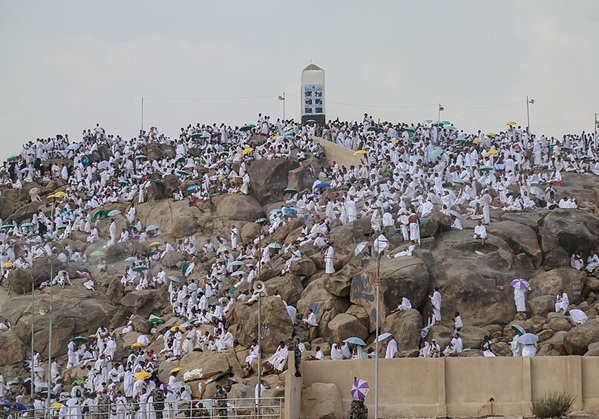
Mount Arafat (Saudipics, 2017) CC BY-SA 4.0
HAJJ AND AWARENESS ON PLASTIC WASTE
Cumulatively, thousands, if not millions, of bottles of water are bought by or distributed to pilgrims in Madinah and Makkah as they stroll up and down the roads and lanes to go and return from the Masjid al-Nabawi and Masjid al-Haram, respectively, as well as during Wuquf in Arafah and their stay (Mabit) in Muzdalifah and Mina. Plastic cups are even provided for pilgrims to drink Zam-Zam water in the two Holy Mosques. Pilgrims are also offered plastic bags at the mosque's entrance to keep their shoes. Moreover, various organizations and individuals distribute free meals as acts of charity and worship (Fi Sabil) to pilgrims. However, the meals come with plastic packaging. Additionally, pilgrims who shop for necessities or souvenirs for family and friends back home also use a significant number of plastic bags. Most restaurants in Makkah and Madinah also use disposable plastic plates and cups.
Therefore, while the spiritual journey of Hajj may bring economic benefits to Saudi Arabia, it also generates a substantial environmental burden, particularly in terms of plastic waste. A significant portion of this waste originates from single-use plastic bags, drinking bottles, food packaging, and storage containers (Alshammari, 2025). Nizami et al. (2015) reported that approximately 3,853 tons of waste were generated daily during the Ramadan and Hajj period in 2014 alone, with plastic waste accounting for 23% of the total. Considering the environmental and health impacts of plastic waste, Muslims should adopt more responsible behaviour regarding plastic use during Hajj, as this aligns with core Islamic teachings. Among others, Islam prohibits causing harm or mischief on Earth. For instance, God reminds us that:
“Mischief has appeared on land and sea because of (the meed) that the hands of men have earned…”.
(Surah Ar-Ruum: Verse 41)
Polluting the environment with plastic waste causes mischief not only to the environment but also to other humans. Apart from that, Islam emphasizes the importance of cleanliness. There is a hadith which says, "Cleanliness is half of faith" (Sahih Muslim). Emphasizing the importance of cleanliness in Islam, the hadith asks Muslims to be mindful of their cleanliness in all aspects of life. For instance, improper disposal of plastic bottles and food wrappers contradicts this principle. Furthermore, Islam teaches the concept of stewardship (Khalifah), urging Muslims to care for and protect the Earth. Therefore, Muslims must fulfil their religious and environmental duties by minimizing plastic use and waste during the Hajj.
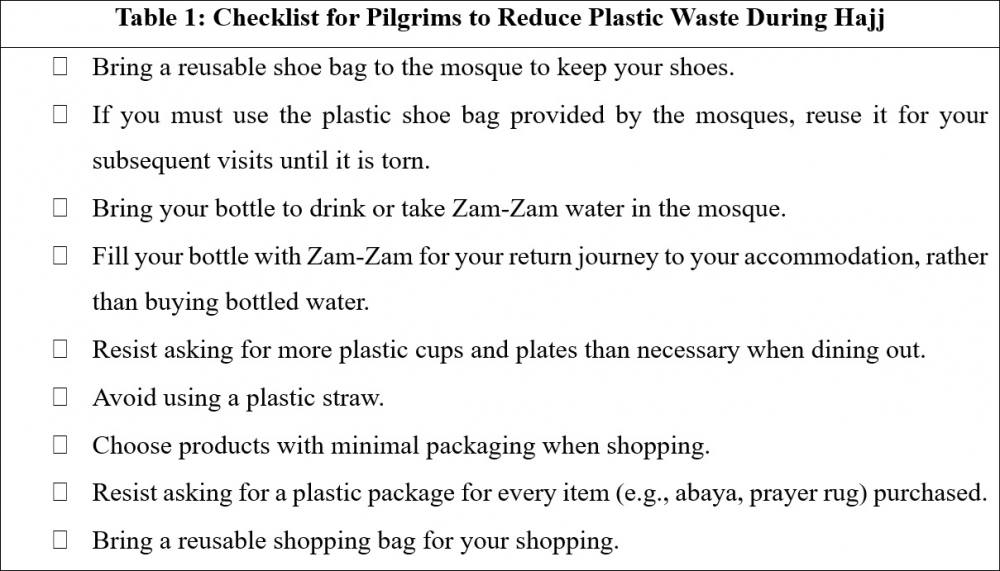
The Hajj pilgrimage generates substantial plastic waste due to the large number of pilgrims and the widespread use of single-use plastics. These wastes are not only a problem for those in Saudi Arabia but will have extended impacts on the world if they reach the ocean. As recycling bins are not commonly found in the two mosques and other places for Hajj rituals, reducing and reusing are the most practical principles for minimizing plastic waste generation by pilgrims for now. Therefore, each pilgrim should act more responsibly by reducing plastic waste by avoiding single-use plastics, opting for reusable alternatives, and supporting businesses that prioritize sustainability. Hajj organizers and local authorities should also provide more sustainable options and promote responsible waste management practices. Table 1 suggests some practical measures that individual pilgrims can take during the Hajj.
Cumulatively, thousands, if not millions, of bottles of water are bought by or distributed to pilgrims in Madinah and Makkah as they stroll up and down the roads and lanes to go and return from the Masjid al-Nabawi and Masjid al-Haram, respectively, as well as during Wuquf in Arafah and their stay (Mabit) in Muzdalifah and Mina. Plastic cups are even provided for pilgrims to drink Zam-Zam water in the two Holy Mosques. Pilgrims are also offered plastic bags at the mosque's entrance to keep their shoes. Moreover, various organizations and individuals distribute free meals as acts of charity and worship (Fi Sabil) to pilgrims. However, the meals come with plastic packaging. Additionally, pilgrims who shop for necessities or souvenirs for family and friends back home also use a significant number of plastic bags. Most restaurants in Makkah and Madinah also use disposable plastic plates and cups.
Therefore, while the spiritual journey of Hajj may bring economic benefits to Saudi Arabia, it also generates a substantial environmental burden, particularly in terms of plastic waste. A significant portion of this waste originates from single-use plastic bags, drinking bottles, food packaging, and storage containers (Alshammari, 2025). Nizami et al. (2015) reported that approximately 3,853 tons of waste were generated daily during the Ramadan and Hajj period in 2014 alone, with plastic waste accounting for 23% of the total. Considering the environmental and health impacts of plastic waste, Muslims should adopt more responsible behaviour regarding plastic use during Hajj, as this aligns with core Islamic teachings. Among others, Islam prohibits causing harm or mischief on Earth. For instance, God reminds us that:
“Mischief has appeared on land and sea because of (the meed) that the hands of men have earned…”.
(Surah Ar-Ruum: Verse 41)
Polluting the environment with plastic waste causes mischief not only to the environment but also to other humans. Apart from that, Islam emphasizes the importance of cleanliness. There is a hadith which says, "Cleanliness is half of faith" (Sahih Muslim). Emphasizing the importance of cleanliness in Islam, the hadith asks Muslims to be mindful of their cleanliness in all aspects of life. For instance, improper disposal of plastic bottles and food wrappers contradicts this principle. Furthermore, Islam teaches the concept of stewardship (Khalifah), urging Muslims to care for and protect the Earth. Therefore, Muslims must fulfil their religious and environmental duties by minimizing plastic use and waste during the Hajj.
The Hajj pilgrimage generates substantial plastic waste due to the large number of pilgrims and the widespread use of single-use plastics. These wastes are not only a problem for those in Saudi Arabia but will have extended impacts on the world if they reach the ocean. As recycling bins are not commonly found in the two mosques and other places for Hajj rituals, reducing and reusing are the most practical principles for minimizing plastic waste generation by pilgrims for now. Therefore, each pilgrim should act more responsibly by reducing plastic waste by avoiding single-use plastics, opting for reusable alternatives, and supporting businesses that prioritize sustainability. Hajj organizers and local authorities should also provide more sustainable options and promote responsible waste management practices. Table 1 suggests some practical measures that individual pilgrims can take during the Hajj.
CONCLUSION
Hajj is an ibadah that every Muslim longs to perform to seek God’s forgiveness and contentment. However, in undertaking this ibadah, Muslims must not forget to maintain good relationships with the environment and other human beings. One way of doing this is by responsibly reducing plastic waste. This measure aligns with Islamic teachings and shows Muslims’ support for achieving the global Sustainable Development Goals.
While individual choices and actions count, a more comprehensive strategy is necessary to address plastic pollution in general, which includes reducing plastic production, increasing recycling rates, and preventing plastic from entering the environment. Accordingly, concerning plastic waste during Hajj, stakeholders in Saudi Arabia must play a more significant role in addressing the issue. The government should create incentives to encourage greener actions from municipalities and the business sector in addressing plastic waste. For instance, the government can adopt the circular economy model to keep resources in use for as long as possible and reduce waste. Municipalities and businesses can provide recycling facilities inside and around the two Holy Mosques, as well as in Arafah, Muzdalifah, and Mina. Additionally, organizations that provide Fi Sabil by distributing drinking water and food should also consider reducing the use of single-use plastic bottles and plastic packaging. All these key stakeholders must make a strategic shift to address plastic waste production, consumption, and disposal during the Hajj period, in addition to the pilgrims themselves.
Hajj is an ibadah that every Muslim longs to perform to seek God’s forgiveness and contentment. However, in undertaking this ibadah, Muslims must not forget to maintain good relationships with the environment and other human beings. One way of doing this is by responsibly reducing plastic waste. This measure aligns with Islamic teachings and shows Muslims’ support for achieving the global Sustainable Development Goals.
While individual choices and actions count, a more comprehensive strategy is necessary to address plastic pollution in general, which includes reducing plastic production, increasing recycling rates, and preventing plastic from entering the environment. Accordingly, concerning plastic waste during Hajj, stakeholders in Saudi Arabia must play a more significant role in addressing the issue. The government should create incentives to encourage greener actions from municipalities and the business sector in addressing plastic waste. For instance, the government can adopt the circular economy model to keep resources in use for as long as possible and reduce waste. Municipalities and businesses can provide recycling facilities inside and around the two Holy Mosques, as well as in Arafah, Muzdalifah, and Mina. Additionally, organizations that provide Fi Sabil by distributing drinking water and food should also consider reducing the use of single-use plastic bottles and plastic packaging. All these key stakeholders must make a strategic shift to address plastic waste production, consumption, and disposal during the Hajj period, in addition to the pilgrims themselves.
REFERENCES
Ali, Abdullah Y. (1946). The Holy Quran: Text, Translation and Commentary Volume One. Beirut: Printing Production.
Alshammari, H. (2025, June 16). How pilgrims can adopt sustainable practices during the Hajj to minimize their environmental impact. Arab News. Retrieved June 25, 2025, from https://www.arabnews.com/node/2603681/saudi-arabia
Li, Y., Chen, L., Zhou, N., Chen, Y., Ling, Z., & Xiang, P. (2024). Microplastics in the human body: A comprehensive review of exposure, distribution, migration mechanisms, and toxicity. Science of the Total Environment, 946, 174215. https://doi.org/10.1016/j.scitotenv.2024.174215
Li, Y., Tao, L., Wang, Q., Wang, F., Li, G., & Song, M. (2023). Potential health impact of microplastics: A review of environmental distribution, human exposure, and toxic effects. Environment & Health, 1(4), 249–257. https://doi.org/10.1021/envhealth.3c00052
Nizami, A.-S., Rehan, M., Ismail, I. M. I., Almeelbi, T., & Ouda, O. K. M. (2015). Waste biorefinery in Makkah: A solution to convert waste produced during the Hajj and Umrah seasons into wealth. In Proceedings of the 15th Scientific Symposium for Hajj, Umrah and Madinah Visit (pp. 93–104). The Custodian of the Two Holy Mosques Institute for Hajj and Umrah Research at Umm Al-Qura University. https://doi.org/10.13140/RG.2.1.4303.6560
Karali, N., Khanna, N., & Shah, N. (2024). Climate impact of primary plastic production. Lawrence Berkeley National Laboratory. https://eta-publications.lbl.gov/sites/default/files/climate_and_plastic_report_final.pdf
saudipics. (2017, August 31). Mount Arafat [Photograph]. saudipics.com. http://saudipics.com/images/preview/84
