

Trees As Carbon Absorbers: Contributing to Climate Change Mitigation and Understanding Their Long-Term Carbon Potential
INTRODUCTION
As the world grapples with the intensifying effects of climate change, solutions to mitigate the crisis have become increasingly urgent. Among the most promising natural mechanisms to address this global challenge are trees, which play a crucial role in absorbing and storing carbon dioxide (CO₂) from the atmosphere.
Through a process called carbon sequestration, trees not only contribute to reducing the concentration of greenhouse gases in the air but also help stabilize the Earth’s climate. The ability of trees to act as carbon sinks, removing and storing carbon, has long been recognized as an essential strategy for fighting climate change. However, it is crucial to understand not only how trees sequester carbon but also the long-term potential they hold in mitigating the impacts of climate change. The process begins when trees absorb CO₂ from the atmosphere and convert it into biomass, storing carbon in their trunks, roots, leaves, and branches. Over time, as trees grow and mature, their capacity to absorb and store carbon increases, making mature forests one of the most significant carbon sinks on the planet. In this article, we will explore the process of carbon sequestration in trees, discuss the factors that influence their carbon storage potential, and understand the broader implications for climate change mitigation through forest conservation and tree planting efforts.
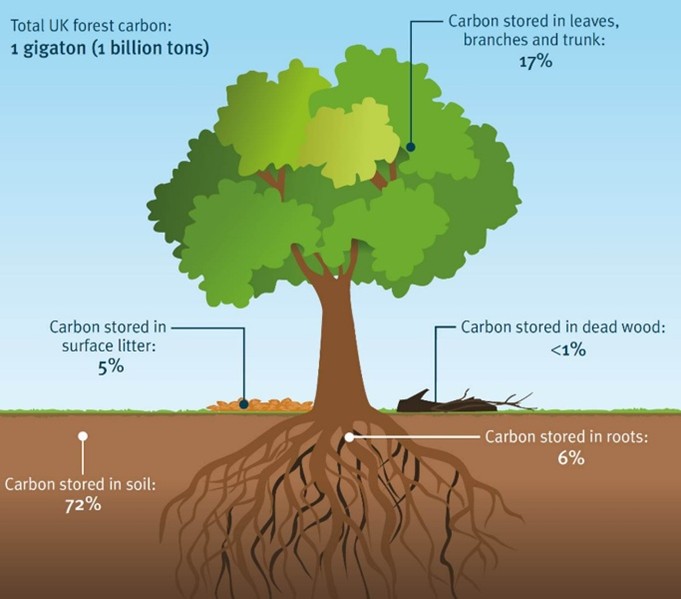
Carbon stored in ecosystems (Source: The Carbon Community)
THE PROCESS OF CARBON SEQUESTRATION IN TREES
Carbon sequestration is the process by which trees and other plants absorb carbon dioxide from the atmosphere through the process of photosynthesis. During this process, trees take in CO₂ through small pores on their leaves called stomata. Using energy from sunlight, trees convert CO₂ and water into glucose (a form of sugar) and oxygen. Trees use the glucose for growth and energy, while the oxygen is released back into the atmosphere. The carbon absorbed by the tree, however, is not released. It is stored in the form of biomass, which includes the tree's trunk, branches, leaves, and roots. This stored carbon is an essential part of the carbon cycle and can remain locked in the tree for as long as it is alive. For example, the trunk of a tree acts as a carbon reservoir, continuously storing carbon as the tree grows. Interestingly, the amount of carbon a tree can store increases as it grows older. Younger trees initially absorb carbon at a rapid rate; however, as they mature, their carbon storage capacity expands, and the biomass continues to increase. Therefore, the process of carbon sequestration is not just a temporary function of trees but rather a long-term contribution to carbon storage in the environment.
FACTORS AFFECTING TREE CARBON STORAGE
While all trees play a role in carbon sequestration, the extent of their contribution depends on several factors, including species, age, environment, and growth conditions. For example, some species of trees, particularly those in tropical regions, have faster growth rates and higher carbon storage potential compared to temperate or boreal species. Tropical forests, with their dense canopy and rapid growth, are particularly efficient at absorbing carbon, often sequestering more carbon per hectare than temperate forests (Luyssaert et al., 2008). Another critical factor influencing carbon storage is the age of the tree. As trees mature, their carbon storage capacity increases, particularly when they reach full maturity. Older trees store carbon not only in their wood but also in their roots and surrounding soil, which further contributes to long-term carbon sequestration. Forests composed of older, larger trees are, therefore, some of the most effective carbon sinks on Earth. Environmental conditions such as soil quality, climate, and water availability also play a role in determining the carbon storage capacity of trees. Healthy soils and favourable growing conditions allow trees to thrive, enhancing their carbon sequestration abilities. For instance, in areas with abundant rainfall and fertile soil, trees can grow more quickly and store more carbon (Pan et al., 2011).
THE ROLE OF FORESTS AS CARBON SINKS
Forests are often referred to as the “lungs of the Earth,” and for good reason. They are the world’s second-largest carbon sink, after oceans, and are responsible for absorbing approximately 30% of global CO₂ emissions each year (Bastin et al., 2020). The ability of forests to store carbon is immense, and their conservation plays a critical role in the global effort to mitigate climate change. Forests are made up of trees that collectively sequester carbon, making them integral to the Earth’s carbon cycle.
However, forests do not just store carbon in the trees themselves; they also store carbon in the soil. As trees grow, they contribute organic matter to the soil, enhancing its ability to store carbon. The roots of trees, for instance, anchor them in the ground and help store carbon beneath the surface. This process of soil carbon sequestration is essential in maintaining the long-term carbon storage capacity of forests (Jackson et al., 2008). The role of forests extends beyond carbon sequestration. Healthy forests regulate water cycles, improve air quality, support biodiversity, and protect against natural disasters such as floods and wildfires. These ecosystems provide a wide range of ecological services that are crucial for the planet’s health.
THE IMPORTANCE OF PROTECTING AND PLANTING TREES
While forests are critical in the fight against climate change, relying solely on existing forests to sequester carbon is not enough. Protecting forests from deforestation and degradation is just as important as planting new trees. When forests are destroyed, the carbon stored in the trees is released back into the atmosphere, worsening the effects of climate change. Furthermore, deforestation reduces the Earth’s ability to absorb carbon in the future. Forest protection efforts, such as the REDD+ program, which provides financial incentives to countries for conserving their forests and reducing deforestation, are critical to maintaining the carbon storage capacity of forests (Angelsen, 2021). Reforestation, the process of planting trees in areas where forests have been lost, also plays an important role in restoring carbon sequestration potential. Tree planting initiatives at both local and global scales can significantly contribute to mitigating climate change by sequestering more CO₂ and replenishing the Earth’s carbon sinks
THE FUTURE OF TREE CARBON SEQUESTRATION
The future of tree-based carbon sequestration looks promising. As global efforts to combat climate change intensify, tree planting and forest conservation will continue to be at the forefront of environmental strategies. Urban areas, often overlooked in carbon sequestration discussions, can also contribute significantly by planting trees in cities. Urban forests help offset carbon emissions, reduce pollution, and enhance the overall quality of life in cities (McDonald et al., 2021). Additionally, advances in technology are improving the monitoring and measurement of tree carbon storage. Tools such as drones, satellite imagery, and remote sensing allow scientists to track forest health and measure carbon sequestration more accurately. These technologies are enabling more effective carbon management and forest conservation, making it easier to understand how trees and forests contribute to the global carbon cycle (Nowak et al., 2021).
CONCLUSION
Trees play a crucial and irreplaceable role in mitigating climate change through carbon sequestration. Their ability to absorb and store carbon, especially as they mature, makes them one of the most effective tools in our fight against global warming. Forests, as carbon sinks, store vast amounts of CO₂, and their protection and conservation are essential for sustaining these benefits. As we look to the future, tree planting, forest conservation, and innovations in carbon monitoring will be vital components of global climate strategies. By ensuring the preservation and growth of trees, we not only combat climate change but also enhance biodiversity, improve air quality, and safeguard the planet’s future for generations to come.
REFERENCES
Angelsen, A. (2021). Transforming REDD+. CIFOR.
Bastin, J.-F., Finegold, Y., Garcia, C., Mollicone, D., Rezende, M., Routh, D., Zohner, C. M., & Crowther, T. W. (2019). The global tree restoration potential. Science, 365(6448), 76–79.
Jackson, R. B., Jobbágy, E. G., Avissar, D., Roy, S. B., Barrett, S. B., Cook, C. W., Farquhar, K. A., & Jackson, J. A. (2008). Protecting soil carbon: the carbon management potential of soil in a changing climate. Nature, 451(7181), 779–780.
Luyssaert, S., Schulze, E. D., Börner, A., Knohl, A., Hessenmöller, D., Law, B. E., Ciais, P., & Grace, J. (2008). Old-growth forests as global carbon sinks. Nature, 455(7210), 213–215.
McDonald, R. I., et al. (2021). The Benefits and Limits of Urban Tree Planting for Environmental and Human Health. Environmental Research Letters, 16(4), 04500.
Nowak, D. J., et al. (2021). Understanding i-Tree: 2021 Summary of Programs and Methods. USDA Forest Service General Technical Report NRS-200.
Pan, Y., Birdsey, R. A., Fang, J., Houghton, R., Kauppi, P. E., Kurz, W. A., Phillips, O. L., Shvidenko, A., Canadell, J. G., Hayes, J. A., Jobbágy, E. G., Prince, S., Running, S. W., & Sala, A. (2011). A Large and Persistent Carbon Sink in the World's Forests. Science, 333(6045), 988–993.
