

Environmentally Sensitive Areas (ESA) in Malaysia: Are We Sensitive Enough?
INTRODUCTION
Malaysia is renowned for its lush rainforests, vibrant biodiversity, and rich ecological landscapes. These unique environmental features are not only national treasures but are also vital to global conservation efforts. In response to the growing threats posed by deforestation, urban sprawl, and industrial pollution, the Malaysian government has adopted the concept of Environmentally Sensitive Areas (ESAs) under the National Physical Plan (NPP). These critical zones require special attention to preserve ecological functions, biodiversity, and natural beauty. However, after more than two decades of strategic planning, one pressing question remains: Are Malaysians truly sensitive enough to protect these areas?
ESAs in Malaysia are classified into three ranks. Rank 1 ESAs are strictly off-limits to development and include protected forests, water catchment areas, and critical habitats. Rank 2 allows limited and controlled development under specific environmental safeguards. Rank 3 permits certain activities under sustainable management practices. This tiered system reflects a thoughtful approach to balancing conservation and development, showcasing Malaysia’s commitment to safeguarding natural assets. While this framework appears comprehensive, its real-world application tells a more complicated story.
CHALLENGES IN ESA IMPLEMENTATION
The pressure from economic activities, particularly tourism and agriculture, adds further complexity. In ecotourism hotspots such as Gunung Tebu, researchers have reported that increasing visitor numbers strain local ecosystems, with minimal infrastructure to support sustainable tourism (Mahyudin et al., 2024). Meanwhile, ESA zones like the Setiu Wetlands in Terengganu are under threat from aquaculture expansion and illegal land conversion, despite their classification as protected areas (Lua et al., 2025). Urban expansion brings new considerations, particularly for areas on the edges of towns and cities. Issues such as noise, waste, and water discharge near ESA zones underline the need to integrate environmental thinking into everyday planning. These are not barriers but opportunities to build greener, more liveable communities. Beyond physical threats, governance and enforcement remain major bottlenecks. Insufficient integration of indigenous knowledge and community involvement undermines long-term sustainability efforts (Fauzi & Mahyudin, 2024). Despite these challenges, there are examples of successful initiatives that provide hope. In Setiu, innovative marine spatial planning has effectively balanced biodiversity conservation with livelihood needs. Meanwhile, technological tools such as drones are now being used to monitor logging trails and forest conditions, helping authorities manage resources more effectively.
CONCLUSION
So, are Malaysians truly sensitive enough toward ESAs? While policies and frameworks are in place, enforcement remains uneven, and public awareness is still lacking. A shift toward a more integrated, data-driven, and community-inclusive approach is needed. Protecting these sensitive areas is not merely an environmental concern but a question of intergenerational responsibility. Malaysia has made commendable progress in recognising and protecting ESA through structured policies and spatial planning tools. While challenges must be addressed, particularly in implementation and stakeholder engagement, numerous opportunities exist to enhance ESA management. Through continued research, inter-agency collaboration, technological adoption, and community participation, Malaysia can strengthen its approach to environmental stewardship in line with the Sustainable Development Goals.
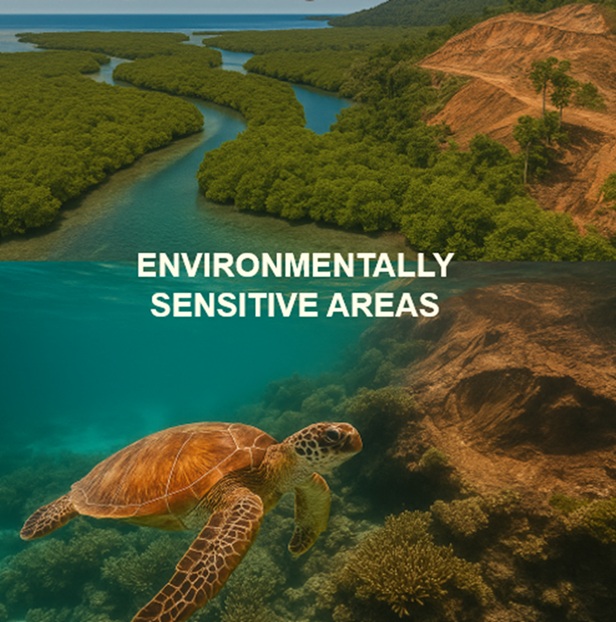
Environmentally sensitive area
REFERENCES
Fauzi, N. A., & Mahyudin, N. A. A. (2024). Avifauna diversity in the environmentally sensitive area: Alpha and Beta analyses in Kluang Forest Reserve, southern Peninsular Malaysia. Biodiversity Data Journal. https://pmc.ncbi.nlm.nih.gov/articles/PMC11589626/
Lua, W. Y., Aziz, N., Idris, I., & Rahman, M. A. A. (2025). Marine spatial planning as a potential practical approach to manage the Setiu Wetland as an ecologically sensitive area. Integrated Environmental Assessment and Management. https://academic.oup.com/ieam/advance-article-abstract/doi/10.1093/inteam/vjaf023/8009005
Mahyudin, N. A. A., Munian, K., & Fauzi, N. A. (2024). Bird diversity in Gunung Tebu Forest Reserve: Biological data of environmentally sensitive area in east coast Peninsular Malaysia. BIO Web of Conferences. https://www.bio-conferences.org/articles/bioconf/pdf/2024/50/bioconf_ctress2024_01007.pdf
Fauzi, N. A., & Mahyudin, N. A. A. (2024). Avifauna diversity in the environmentally sensitive area: Alpha and Beta analyses in Kluang Forest Reserve, southern Peninsular Malaysia. Biodiversity Data Journal. https://pmc.ncbi.nlm.nih.gov/articles/PMC11589626/
Lua, W. Y., Aziz, N., Idris, I., & Rahman, M. A. A. (2025). Marine spatial planning as a potential practical approach to manage the Setiu Wetland as an ecologically sensitive area. Integrated Environmental Assessment and Management. https://academic.oup.com/ieam/advance-article-abstract/doi/10.1093/inteam/vjaf023/8009005
Mahyudin, N. A. A., Munian, K., & Fauzi, N. A. (2024). Bird diversity in Gunung Tebu Forest Reserve: Biological data of environmentally sensitive area in east coast Peninsular Malaysia. BIO Web of Conferences. https://www.bio-conferences.org/articles/bioconf/pdf/2024/50/bioconf_ctress2024_01007.pdf
