

Solar Energy: Challenges in Malaysia
INTRODUCTION
As the global energy transition accelerates, solar energy, a clean and renewable resource, is rapidly emerging as a key solution (Gomesh et al., 2013). Malaysia, a country located near the equator, has abundant sunlight and a stable climate, which provide ideal natural conditions for the growth of the solar energy industry (Muhammad-Sukki et al., 2011a). Against the backdrop of global warming, the Malaysian government has recognized the drawbacks of relying on traditional fossil fuels and is actively pursuing a greener energy transition. Solar energy has been identified as one of the strategic priorities in the nation's energy development agenda. However, despite the promising opportunities, the development of solar energy in Malaysia faces various challenges.
MALAYSIA'S GOVERNMENT ACTIVELY PROMOTING SOLAR ENERGY
Solar energy, derived from solar radiation, is one of Earth's most widely utilized, clean, and sustainable energy sources. As a critical component of clean energy, solar power holds immense potential in reducing carbon emissions. In Malaysia, annual solar irradiation ranges from 1,400 to 1,900 kWh/m², averaging around 1,643 kWh/m²(Muhammad-Sukki et al., 2011b). With over 10 hours of daily sunshine, the country enjoys ideal conditions for solar energy generation.
In 2009, Malaysia introduced the National Green Technology Policy (NGTP), which emphasized the application of green technologies in energy, construction, water and waste management, and transportation sectors. This marked a significant step toward sustainable development. In 2011, the country enacted the Renewable Energy Act to promote renewable energy generation by implementing the Feed-in Tariff (FiT) system. FiT supports various renewable energy sources, including solar, wind, hydropower, and biomass. FiT encouraged households and businesses to install solar photovoltaic (PV) systems and sell surplus electricity back to the grid by providing long-term, stable price subsidies. FiT offered generous subsidies in its early years, which played a crucial role in driving the initial development of solar projects.
However, from 2017 onwards, these subsidies were gradually reduced, leading to a decline in new project deployments. In 2016, Malaysia launched the Net Energy Metering (NEM) program, allowing solar energy users to return surplus electricity to the grid in exchange for electricity bill offsets. This initiative promoted a combination of self-consumption and grid integration, enhancing the economic viability of solar energy systems. NEM underwent further improvements, with NEM 2.0 introducing a "one-to-one" energy offset mechanism, significantly increasing policy attractiveness. NEM 3.0 expanded the program’s scope by dividing quotas into three categories: residential users, commercial users, and government sectors. By 2022, the utilization of NEM quotas had steadily increased, though slow approval processes prevented some quotas from being converted into installed capacity promptly. In the same year, Malaysia launched the Large Scale Solar (LSS) program to facilitate the construction of large-scale solar power plants through open bidding. This approach reduced generation costs, attracted private investment, and significantly improved the cost-efficiency of solar energy projects. LSS successfully drew participation from numerous domestic and international enterprises, optimizing the economies of scale for solar power and increasing its share in the national energy mix. However, land acquisition difficulties and project approval delays hindered some awarded projects. These initiatives collectively promoted the commercialization and scaling of solar energy in Malaysia. In 2023, the Malaysian government approved the National Energy Transition Roadmap (NETR), which aims to achieve 70% renewable energy capacity in the national energy mix by 2050.Malaysia has demonstrated its commitment to energy transition and sustainable development by establishing a policy framework centred on legal structures, incentive mechanisms, and long-term planning. These efforts mark the country as a leader in the shift toward a greener energy future.
CHALLENGES IN MALAYSIA’S SOLAR ENERGY DEVELOPMENT
Malaysia is a significant production hub for six leading photovoltaic (PV) manufacturing companies and the third-largest solar panel producer globally. It has become one of the major suppliers of solar components worldwide, with export markets spanning Southeast Asia, Europe, and North America. This industrial advantage not only strengthens Malaysia’s position in the international PV market but also provides technical and financial support for developing its domestic solar energy industry. By 2023, the country’s solar installed capacity had reached 2.6 GW, marking a 26-fold increase from 0.1 GW in 2011. However, despite this impressive growth, solar power contributes less than 2% of Malaysia’s electricity generation. According to the NETR, Malaysia has set ambitious renewable energy targets. By 2040, the installed renewable energy capacity is expected to reach 52% of the total, with solar PV accounting for 27 GW. By 2050, the share of renewable energy is projected to rise to 70%, with solar PV installed capacity expanding to 57 GW. Despite the progress, a significant gap exists between current solar capacity and these long-term targets.
As the global energy transition accelerates, solar energy, a clean and renewable resource, is rapidly emerging as a key solution (Gomesh et al., 2013). Malaysia, a country located near the equator, has abundant sunlight and a stable climate, which provide ideal natural conditions for the growth of the solar energy industry (Muhammad-Sukki et al., 2011a). Against the backdrop of global warming, the Malaysian government has recognized the drawbacks of relying on traditional fossil fuels and is actively pursuing a greener energy transition. Solar energy has been identified as one of the strategic priorities in the nation's energy development agenda. However, despite the promising opportunities, the development of solar energy in Malaysia faces various challenges.
MALAYSIA'S GOVERNMENT ACTIVELY PROMOTING SOLAR ENERGY
Solar energy, derived from solar radiation, is one of Earth's most widely utilized, clean, and sustainable energy sources. As a critical component of clean energy, solar power holds immense potential in reducing carbon emissions. In Malaysia, annual solar irradiation ranges from 1,400 to 1,900 kWh/m², averaging around 1,643 kWh/m²(Muhammad-Sukki et al., 2011b). With over 10 hours of daily sunshine, the country enjoys ideal conditions for solar energy generation.
In 2009, Malaysia introduced the National Green Technology Policy (NGTP), which emphasized the application of green technologies in energy, construction, water and waste management, and transportation sectors. This marked a significant step toward sustainable development. In 2011, the country enacted the Renewable Energy Act to promote renewable energy generation by implementing the Feed-in Tariff (FiT) system. FiT supports various renewable energy sources, including solar, wind, hydropower, and biomass. FiT encouraged households and businesses to install solar photovoltaic (PV) systems and sell surplus electricity back to the grid by providing long-term, stable price subsidies. FiT offered generous subsidies in its early years, which played a crucial role in driving the initial development of solar projects.
However, from 2017 onwards, these subsidies were gradually reduced, leading to a decline in new project deployments. In 2016, Malaysia launched the Net Energy Metering (NEM) program, allowing solar energy users to return surplus electricity to the grid in exchange for electricity bill offsets. This initiative promoted a combination of self-consumption and grid integration, enhancing the economic viability of solar energy systems. NEM underwent further improvements, with NEM 2.0 introducing a "one-to-one" energy offset mechanism, significantly increasing policy attractiveness. NEM 3.0 expanded the program’s scope by dividing quotas into three categories: residential users, commercial users, and government sectors. By 2022, the utilization of NEM quotas had steadily increased, though slow approval processes prevented some quotas from being converted into installed capacity promptly. In the same year, Malaysia launched the Large Scale Solar (LSS) program to facilitate the construction of large-scale solar power plants through open bidding. This approach reduced generation costs, attracted private investment, and significantly improved the cost-efficiency of solar energy projects. LSS successfully drew participation from numerous domestic and international enterprises, optimizing the economies of scale for solar power and increasing its share in the national energy mix. However, land acquisition difficulties and project approval delays hindered some awarded projects. These initiatives collectively promoted the commercialization and scaling of solar energy in Malaysia. In 2023, the Malaysian government approved the National Energy Transition Roadmap (NETR), which aims to achieve 70% renewable energy capacity in the national energy mix by 2050.Malaysia has demonstrated its commitment to energy transition and sustainable development by establishing a policy framework centred on legal structures, incentive mechanisms, and long-term planning. These efforts mark the country as a leader in the shift toward a greener energy future.
CHALLENGES IN MALAYSIA’S SOLAR ENERGY DEVELOPMENT
Malaysia is a significant production hub for six leading photovoltaic (PV) manufacturing companies and the third-largest solar panel producer globally. It has become one of the major suppliers of solar components worldwide, with export markets spanning Southeast Asia, Europe, and North America. This industrial advantage not only strengthens Malaysia’s position in the international PV market but also provides technical and financial support for developing its domestic solar energy industry. By 2023, the country’s solar installed capacity had reached 2.6 GW, marking a 26-fold increase from 0.1 GW in 2011. However, despite this impressive growth, solar power contributes less than 2% of Malaysia’s electricity generation. According to the NETR, Malaysia has set ambitious renewable energy targets. By 2040, the installed renewable energy capacity is expected to reach 52% of the total, with solar PV accounting for 27 GW. By 2050, the share of renewable energy is projected to rise to 70%, with solar PV installed capacity expanding to 57 GW. Despite the progress, a significant gap exists between current solar capacity and these long-term targets.
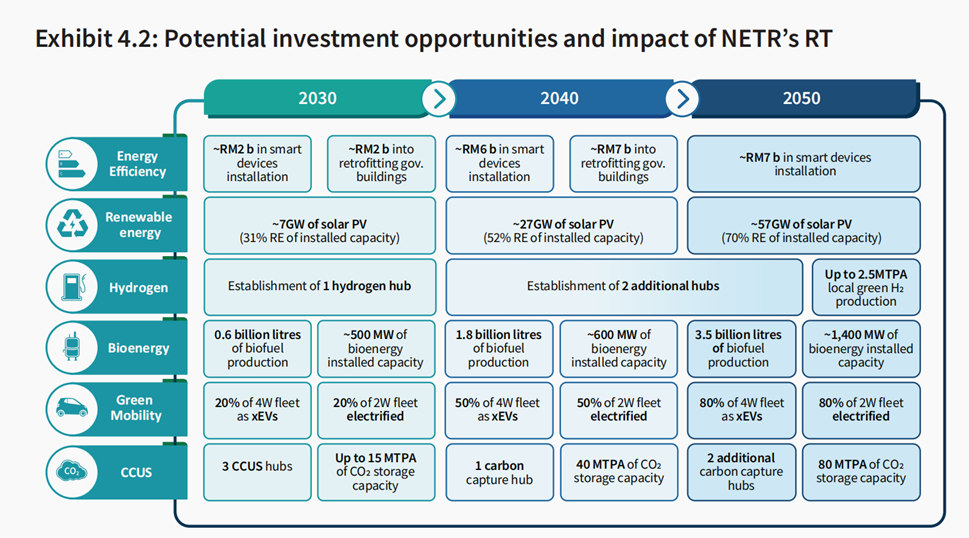
Source: NETR (National Energy Transition Roadmap)
Several challenges hinder the development of solar PV in Malaysia, including:
i. Insufficient Sustainability and Strength of Incentives
In 2011, Malaysia introduced the FiT system, which offered long-term, stable electricity subsidies to attract significant investment in solar energy project development. This mechanism achieved remarkable success in its early stages, driving rapid growth in the domestic photovoltaic (PV) industry. However, starting in 2017, the subsidies under the FiT policy were gradually reduced, leading to a decline in new projects and a slowdown in the solar market's growth. The LSS programme has driven the development of large-scale solar power projects through a bidding mechanism. While LSS has effectively reduced generation costs, the low bidding prices have significantly compressed profit margins for developers. This has disproportionately impacted small and medium-sized enterprises (SMEs), which often lack the financial strength to secure projects through competitive bidding or face insufficient financing support to complete project development. Consequently, many SMEs have been forced to exit the market. Additionally, the low bidding prices have led developers to prioritise cost minimisation, which has reduced investments in innovative technologies and, in turn, hindered technological advancement within the industry. Although these measures have successfully facilitated the scaling of the solar energy market, incentives for SMEs, residential users, and community-level initiatives remain inadequate, limiting the inclusiveness of solar energy adoption.
ii. Lack of Support for Solar PV Storage Technology
As a critical supporting infrastructure for solar power generation, energy storage technology is essential for enhancing its continuity and stability. Research shows (Uz & Mamkhezri, 2024) that the reliability and consistency of solar energy significantly influence consumer choices. According to the NETR, Malaysia will need at least 10 GW of energy storage capacity by 2050. However, the current installed capacity is less than 1 GW. The lack of supporting energy storage facilities significantly limits the utilisation of solar power. The intermittent nature of solar energy generation causes substantial fluctuations in grid load. Solar power output highly depends on weather conditions and time of day, with peak generation periods (e.g., midday) producing excess electricity.
In contrast, generation capacity decreases during nighttime and cloudy periods, resulting in supply variability. During peak generation periods, the absence of adequate energy storage facilities prevents surplus electricity from being stored, leading to significant resource wastage and reducing the economic viability of solar projects. The high initial installation and operational costs of energy storage technology impose substantial financial pressure on businesses and project developers. Moreover, government investment and incentive policies for energy storage remain insufficient, with a lack of dedicated subsidies and financing support to encourage the adoption of storage technologies.
iii. Delays in Upgrading Grid Infrastructure
As solar power generation increases, the delayed upgrading of grid infrastructure has significantly constrained its development. Solar energy's intermittent and variable characteristics place higher demands on the capacity, distribution efficiency, and stability of existing grids. However, the current grid system is not yet adequately equipped regarding hardware facilities, intelligent management, or storage capabilities. Due to insufficient grid absorption capacity, electricity generated during peak solar production periods is often wasted because it cannot be utilised effectively. Moreover, the lack of integration between intelligent dispatch systems and energy storage solutions prevents the grid from balancing supply and demand dynamically, leaving it poorly equipped to respond to sudden load changes and fluctuations. In remote and rural areas, insufficient investment in grid construction, ageing transmission and distribution lines, and limited capacity further hinder the integration of large-scale renewable energy. These challenges significantly restrict the potential for solar energy to be fully utilized in Malaysia’s energy mix.
iv. Insufficient Public Adoption of Solar Energy
Although the Malaysian government has implemented various policies to promote solar energy, public acceptance and adoption remain insufficient. Multiple factors influence this issue, including awareness, financial capability, policy design, and technological support. (Badole et al., 2024). Many members of the public lack awareness of solar energy's long-term economic benefits and environmental value. They fail to recognise that solar energy can reduce electricity bills and significantly lower carbon emissions, offering positive impacts on the environment and society. Although solar systems provide high long-term returns, the initial installation cost of solar PV panels—ranging from RM 4,500 to over RM 6,000 kW—is prohibitive for low-income households. Many families remain hesitant to bear the high upfront costs even with loan or instalment payment options. Government incentive policies are primarily directed at corporate users, with limited coverage for residential users, particularly low-income families. For instance, during the initial phase of the NEM programme, the focus was mainly on commercial users, resulting in low public participation. Although NEM 3.0 has allocated more quotas to residential users, limited public awareness due to inadequate policy promotion hinders participation. Additionally, the complex and time-consuming application process further discourages public users from engaging with solar projects. The promotion of solar energy also faces challenges related to insufficient technical support. On the one hand, many people lack knowledge about installing, maintaining, and operating solar systems, leading to concerns about potential technical risks. On the other hand, the absence of specialised technical service platforms or intermediaries makes it difficult for the public to obtain reliable advice and support when choosing solar solutions. This information gap further impacts public adoption of solar energy.
CONCLUSION
Malaysia has made significant progress in solar energy development, leveraging abundant sunlight and robust policy support. However, challenges such as insufficient policy incentives, lagging energy storage technology, delayed grid upgrades, and low public engagement continue to hinder further advancement. To achieve the ambitious target of 70% renewable energy capacity by 2050, it is crucial to strengthen policy implementation, enhance technological support, and prioritize public education. These measures will be instrumental in accelerating Malaysia’s green energy transition and fostering a more sustainable energy structure.
REFERENCES
Malaysia Ministry of Economy. (2023). National Energy Transition Roadmap (NETR).
Badole, S. B., Bird, S., Heintzelman, M. D., & Legault, L. (2024). Willingness to pay for solar adoption: Economic, ideological, motivational, and demographic factors. Energy Economics, 136, 107703. https://doi.org/10.1016/j.eneco.2024.107703
Gomesh, N., Daut, I., Irwanto, M., Irwan, Y. M., & Fitra, M. (2013). Study on Malaysian’s Perspective Towards Renewable Energy Mainly on Solar Energy. Energy Procedia, 36, 303–312. https://doi.org/10.1016/j.egypro.2013.07.035
Muhammad-Sukki, F., Ramirez-Iniguez, R., Abu-Bakar, S. H., McMeekin, S. G., & Stewart, B. G. (2011a). An evaluation of the installation of solar photovoltaic in residential houses in Malaysia: Past, present, and future. Energy Policy, 39(12), 7975–7987. https://doi.org/10.1016/j.enpol.2011.09.052
Muhammad-Sukki, F., Ramirez-Iniguez, R., Abu-Bakar, S. H., McMeekin, S. G., & Stewart, B. G. (2011b). An evaluation of the installation of solar photovoltaic in residential houses in Malaysia: Past, present, and future. Energy Policy, 39(12), 7975–7987. https://doi.org/10.1016/j.enpol.2011.09.052.
Uz, D., & Mamkhezri, J. (2024). Household willingness to pay for various attributes of residential solar panels: Evidence from a discrete choice experiment. Energy Economics, 130, 107277. https://doi.org/10.1016/j.eneco.2023.107277
