

Malaysia's Commitment to Sustainable Forestry and Global Climate Initiatives
INTRODUCTION
Forests are crucial in mitigating climate change, acting as carbon sinks that absorb large amounts of atmospheric carbon dioxide. As the world faces the escalating impacts of climate change, countries increasingly recognise the importance of preserving and managing their forest resources sustainably. Malaysia, endowed with rich tropical forests, has emerged as a key player in global climate efforts. Malaysia has adopted a proactive approach to sustainable forestry through its commitments under the Paris Agreement and other international frameworks, integrating conservation, community-based management, and technological innovation into its national policies.
Malaysia’s Nationally Determined Contribution (NDC) outlines ambitious targets, including a 45% reduction in carbon intensity by 2030, driven mainly by sustainable forest management practices. The country’s efforts reflect a comprehensive approach that balances environmental conservation with economic development. By implementing Sustainable Forest Management (SFM), participating in the REDD+ program, and engaging local communities in forest stewardship, Malaysia demonstrates its commitment to maintaining its forests as a key component of both national and global climate strategies.
A key element of Malaysia’s Nationally Determined Contribution (NDC)
Figure 1 shows the key elements of Malaysia’s updated Nationally Determined Contribution (NDC) in its climate change strategy.
Malaysia aims to reduce its economy-wide carbon intensity by 45% by the year 2030 compared to 2005 levels. This includes an increase in ambition by 10% from previous commitments. The 45% reduction target is unconditional, meaning it will be achieved without reliance on international financial aid or support mechanisms. Malaysia's NDC covers several key sectors such as Energy, Industrial processes,Waste, Agriculture, Land use, land-use change, and forestry (LULUCF). The country follows the 2006 IPCC Guidelines for National Greenhouse Gas Inventories and focuses on achieving transparency, accuracy, consistency, comparability, and completeness (TACCC) in its accounting approach. These elements reflect Malaysia’s commitment to climate action and its structured approach toward achieving measurable emissions reductions.
Forests are crucial in mitigating climate change, acting as carbon sinks that absorb large amounts of atmospheric carbon dioxide. As the world faces the escalating impacts of climate change, countries increasingly recognise the importance of preserving and managing their forest resources sustainably. Malaysia, endowed with rich tropical forests, has emerged as a key player in global climate efforts. Malaysia has adopted a proactive approach to sustainable forestry through its commitments under the Paris Agreement and other international frameworks, integrating conservation, community-based management, and technological innovation into its national policies.
Malaysia’s Nationally Determined Contribution (NDC) outlines ambitious targets, including a 45% reduction in carbon intensity by 2030, driven mainly by sustainable forest management practices. The country’s efforts reflect a comprehensive approach that balances environmental conservation with economic development. By implementing Sustainable Forest Management (SFM), participating in the REDD+ program, and engaging local communities in forest stewardship, Malaysia demonstrates its commitment to maintaining its forests as a key component of both national and global climate strategies.
A key element of Malaysia’s Nationally Determined Contribution (NDC)
Figure 1 shows the key elements of Malaysia’s updated Nationally Determined Contribution (NDC) in its climate change strategy.
Malaysia aims to reduce its economy-wide carbon intensity by 45% by the year 2030 compared to 2005 levels. This includes an increase in ambition by 10% from previous commitments. The 45% reduction target is unconditional, meaning it will be achieved without reliance on international financial aid or support mechanisms. Malaysia's NDC covers several key sectors such as Energy, Industrial processes,Waste, Agriculture, Land use, land-use change, and forestry (LULUCF). The country follows the 2006 IPCC Guidelines for National Greenhouse Gas Inventories and focuses on achieving transparency, accuracy, consistency, comparability, and completeness (TACCC) in its accounting approach. These elements reflect Malaysia’s commitment to climate action and its structured approach toward achieving measurable emissions reductions.
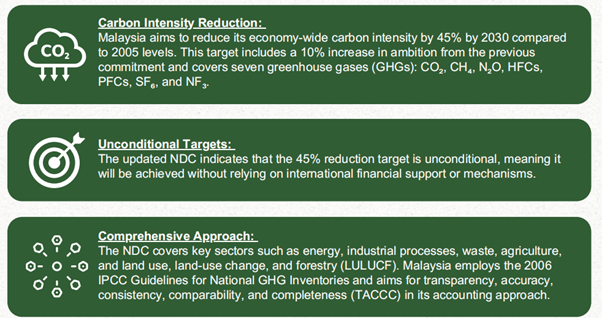
Figure 1. Malaysia’s Nationally Determined Contribution (NDC) climate change strategy.
WAY FORWARD: STRENGTHENING MALAYSIA'S SUSTAINABLE FORESTRY AND CLIMATE CHANGE COMMITMENTS.
As Malaysia strives to meet its climate goals and safeguard its forests, strengthening the enforcement of forest laws is crucial. While the country has made progress in protecting its forests, illegal logging and unsustainable land-use practices remain significant challenges. To address these, Malaysia should expand its use of remote sensing technologies and drones to monitor forests in real-time, enabling rapid detection and intervention against illegal activities. Furthermore, fostering collaboration between government agencies and local communities will be essential to improving the effectiveness of law enforcement. Empowering communities to report violations and enhancing penalties for forest law infractions will ensure that these laws are more robustly upheld.
Involving local communities in forest management will enhance conservation efforts while promoting sustainable livelihoods. Expanding community-based forest management (CBFM) initiatives, where local populations are trained in sustainable harvesting and agroforestry techniques, can strike a balance between conservation and economic benefit. Providing financial incentives and capacity-building opportunities for indigenous and rural communities is essential in ensuring their active participation in forest stewardship. Additionally, the development of eco-tourism ventures could create alternative income sources for these communities while preserving their local ecosystems, promoting sustainable development alongside forest conservation.
Last but not least, Malaysia's future in sustainable forestry lies in harnessing technological innovation and strengthening regional and global partnerships. The integration of artificial intelligence (AI) and big data analytics can predict deforestation risks and refine forest management strategies, while blockchain technology can improve transparency in timber supply chains. On a global scale, enhancing partnerships with ASEAN members and participating in carbon markets will enable Malaysia to benefit from climate finance mechanisms such as carbon trading. Engaging in climate diplomacy and fostering education and awareness among its population will ensure that forest conservation remains a priority for government agencies and society as a whole. By taking these steps, Malaysia can solidify its role as a leader in sustainable forestry and global climate action.
CONCLUSION
In conclusion, Malaysia’s commitment to sustainable forestry is essential for achieving its climate goals and preserving its rich biodiversity. The country can address the ongoing challenges of deforestation and illegal logging by strengthening law enforcement, empowering local communities, and leveraging technological innovation. Furthermore, fostering regional and global partnerships, alongside raising awareness, will enhance Malaysia’s role in international climate initiatives. Through these actions, Malaysia can ensure that its forests continue contributing to national development and the global fight against climate change.
REFERENCES
Food and Agriculture Organization (FAO). (2020). Global Forest Resources Assessment 2020: Malaysia Country Report.
Forest Research Institute Malaysia (FRIM). (2021). Sustainable Forest Management in Malaysia: Practices and Challenges.
Ministry of Energy and Natural Resources, Malaysia (KeTSA). (2020). Malaysia's Fourth National Communication and Second Biennial Update Report to the UNFCCC.
REDD+ Malaysia. (2022). National REDD+ Strategy Malaysia.
United Nations Framework Convention on Climate Change (UNFCCC). (2020). Malaysia's Nationally Determined Contribution (NDC).
