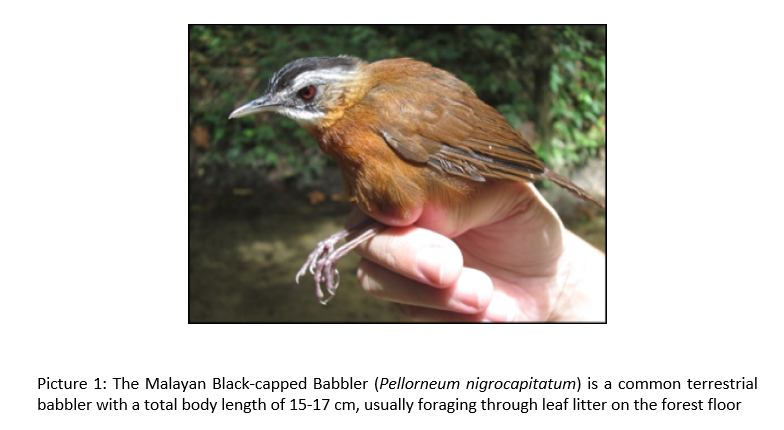
Forest birds comprise diverse feeding guilds that play a crucial ecological role in the forest ecosystem (Stratford & Sekercioglu, 2015). Many frugivores are agents for seed dispersal and pollination, whereas insectivores, on the other hand, control the insect populations in the forest (Sekercioglu, 2006). Insectivorous birds are more vulnerable to forest disturbance (Sodhi et al., 2004) than other feeding guilds (Yong et al., 2011; Mansor & Ramli, 2017) due to their high habitat specificity and relatively poor dispersal ability. When forest habitats are altered or cleared, the understory insectivores will be more likely to be affected due to the loss of the associated habitat requirements and their inability to survive in disturbed habitats (Powell et al., 2015).
In most Asian tropical rainforests, babblers are the most diverse and well-represented insectivorous group (Moyle et al., 2012; Powell et al., 2015). Specifically, in the Malaysian rainforests, babblers are one of the significant insectivorous bird groups (Yong et al., 2011; Mansor & Ramli, 2017); most species are non-migratory and restricted to the forest interior, making them suitable for biogeographic studies (Moyle et al., 2012). Previous studies on the diet of forest babblers in the Malaysian tropical forest have shown that their primary insect prey includes beetles, ants, cockroaches and spiders (Mansor et al., 2018; Mansor & Ramli, 2017).
With high species diversity, previous studies have shown that most babblers have high habitat and foraging specificity and dietary segregation (Mansor & Ramli, 2017; Mansor et al., 2018; 2022; Mohd-Azlan et al., 2022) yet are sensitive to forest fragmentation (Lambert & Collar, 2002, Moradi & Zakaria, 2010; Yong et al., 2011). In the tropical forest ecosystems of Malaysia, babblers, mainly referring to species from the Timaliidae and Pellorneidae families, form a major portion of avian insectivores in the middle and understorey strata. This implies more potential research topics can be explored in such ecosystems, particularly community ecology, such as trophic diversification, resource partitioning, and functional morphology. Since babbler species are also vocally distinctive, the bioacoustic method is another research approach that can aid in our understanding of the tropical avian assemblages as well as the protection of these species via long-term forest monitoring.
REFERENCES
Lambert, F.R., & Collar, N.J. 2002. The future for Sundaic lowland forest birds: Long-term effects of commercial logging and fragmentation. Forktail 18: 127-146.
Mansor, M.S., Abdullah, N.A., Halim, M.R.A., S., Nor, S.M., & Ramli, R. 2018. Diet of tropical insectivorous birds in lowland Malaysian rainforest. Journal of Natural History 52: 35-36.
Mansor, M.S., & Ramli, R. 2017. Foraging niche segregation in Malaysian babblers (Family: Timaliidae). PLoS ONE 12(3): e0172836.
Mansor, M.S., Rozali, F.Z., Davies, S., Nor, S.M., & Ramli, R. 2022. High-throughput sequencing reveals dietary segregation in Malaysian babblers. Current Zoology 68(4): 381-389.
Mohd-Azlan, J., Sapian, A.F., Tuen, A.A., & Puan, C.L. 2022. Foraging strata and dietary preferences of fifteen species of babblers in Sarawak, Malaysia. Journal of Threatened Taxa 14(9): 21818-21825.
Moradi, H.V., & Zakaria, M. 2010. Responses of babblers (Timaliidae) to the forest edge-interior gradient in an isolated tropical rainforest in Peninsular Malaysia. Journal of Tropical Forest Science 22(1): 36-48.
Moyle, R.G., Andersen, M.J., Oliveros, C.H., Steinheimer, F.D., & Reddy, S. 2012. Phylogeny and biogeography of the core babblers (Aves: Timaliidae). Systematic Biology 61(4): 631-651.
Powell, L.L., Cordeiro, N.J., & Stratford, J.A. 2015. Ecology and conservation of avian insectivores of the rainforest understory: A pantropical perspective. Biological Conservation 188: 1-10.
Sekercioglu, C.H. (2006). Increasing awareness of avian ecological function. Trends in Ecology and Evolution. 21(8): 464-471.
Sodhi, N.S., Koh, L.P., Brook, B.W., & Ng, P.K.L. 2004. Southeast Asian biodiversity: an impending disaster. Trends in Ecology and Evolution 19(12): 654-660.
Stratford, J.A., & Sekercioglu, C.H. (2015). Handbook of Forest Ecology. Retrieved from www.researchgate.net/publication/262765408_Birds_in_Forest_Ecosystems
Yong, D.L., Sodhi, N.S., Koh, L.P., Peh, K.S.H., Lee, T.M., Lim, H.C., & Lim, S. L.H. (2011). Do insectivorous bird communities decline on land-bridge forest islands in Peninsular Malaysia? Journal of Tropical Ecology 27(1): 1-14.