

Implementation of ESG in Timber Industries
Introduction
The timber industry, spanning from tree harvesting to the production of wood-based products, is a cornerstone of global economies. Forests, the lifeblood of this industry, provide many ecosystem services, including carbon sequestration, biodiversity conservation, and watershed protection. Beyond their ecological role, forests have been humanity's primary source of building materials and fuel for millennia. The timber industry, consequently, has deep historical roots and continues to be a significant economic driver for many nations. Wood-based products are ubiquitous in modern life, from construction and furniture to paper and packaging. The industry supports millions of jobs, both directly in forestry and manufacturing and indirectly in transportation, logistics, and retail. Moreover, it contributes substantially to export revenues for many countries, particularly those with vast forest resources. However, the industry has also faced growing scrutiny due to its environmental impact, necessitating a shift towards sustainable practices.
ESG, an acronym for Environmental, Social, and Governance, is a framework used to evaluate a company's performance in these three areas(What Is ESG? Environmental, Social, and Governance | Workiva, n.d.). The environmental component considers a company's impact on the planet, such as its carbon footprint, waste management, and resource consumption(What Is ESG Investing? n.d.). The social aspect focuses on a company's relationship with its employees, customers, suppliers, and the communities in which it operates(ESG 101: What Does Social in ESG Mean? | Blog | OneTrust, n.d.). This includes factors like labour practices, human rights, and community involvement. Lastly, governance encompasses a company's leadership, executive pay, audits, internal controls, and shareholder rights(ESG: Environmental, Social, & Governance Investing Explained, n.d.).
The timber industry is intrinsically linked to the environment, making ESG considerations paramount. Given the industry's reliance on forests, environmental factors such as deforestation, biodiversity loss, and climate change mitigation are critical. Social aspects include the welfare of workers, particularly those in vulnerable supply chain segments, and the rights of indigenous communities. Governance is essential for ensuring transparency, accountability, and responsible forest management practices(Understanding Forest Governance - Forest Governance Index, n.d.). By integrating ESG principles, the timber industry can mitigate its environmental impact, enhance social responsibility, and improve its overall reputation and long-term sustainability.
Despite the growing recognition of ESG's importance in various sectors, the timber industry has faced challenges in fully integrating these principles into its operations. While some industry leaders have made significant strides, a comprehensive understanding of the barriers, opportunities, and best practices for ESG implementation remains limited. Existing research often focuses on specific aspects of ESG, such as deforestation or supply chain transparency, rather than providing a holistic view of the industry's ESG performance.
This review aims to bridge this knowledge gap by systematically examining the current state of ESG implementation in the timber industry. By exploring the environmental, social, and governance challenges and opportunities, this research seeks to identify key factors influencing successful ESG integration. Furthermore, the review will analyse existing ESG frameworks and reporting practices, providing recommendations for enhancing transparency and accountability within the sector. Ultimately, the goal is to contribute to developing effective strategies for promoting sustainable and responsible practices in the timber industry.
The timber industry, spanning from tree harvesting to the production of wood-based products, is a cornerstone of global economies. Forests, the lifeblood of this industry, provide many ecosystem services, including carbon sequestration, biodiversity conservation, and watershed protection. Beyond their ecological role, forests have been humanity's primary source of building materials and fuel for millennia. The timber industry, consequently, has deep historical roots and continues to be a significant economic driver for many nations. Wood-based products are ubiquitous in modern life, from construction and furniture to paper and packaging. The industry supports millions of jobs, both directly in forestry and manufacturing and indirectly in transportation, logistics, and retail. Moreover, it contributes substantially to export revenues for many countries, particularly those with vast forest resources. However, the industry has also faced growing scrutiny due to its environmental impact, necessitating a shift towards sustainable practices.
ESG, an acronym for Environmental, Social, and Governance, is a framework used to evaluate a company's performance in these three areas(What Is ESG? Environmental, Social, and Governance | Workiva, n.d.). The environmental component considers a company's impact on the planet, such as its carbon footprint, waste management, and resource consumption(What Is ESG Investing? n.d.). The social aspect focuses on a company's relationship with its employees, customers, suppliers, and the communities in which it operates(ESG 101: What Does Social in ESG Mean? | Blog | OneTrust, n.d.). This includes factors like labour practices, human rights, and community involvement. Lastly, governance encompasses a company's leadership, executive pay, audits, internal controls, and shareholder rights(ESG: Environmental, Social, & Governance Investing Explained, n.d.).
The timber industry is intrinsically linked to the environment, making ESG considerations paramount. Given the industry's reliance on forests, environmental factors such as deforestation, biodiversity loss, and climate change mitigation are critical. Social aspects include the welfare of workers, particularly those in vulnerable supply chain segments, and the rights of indigenous communities. Governance is essential for ensuring transparency, accountability, and responsible forest management practices(Understanding Forest Governance - Forest Governance Index, n.d.). By integrating ESG principles, the timber industry can mitigate its environmental impact, enhance social responsibility, and improve its overall reputation and long-term sustainability.
Despite the growing recognition of ESG's importance in various sectors, the timber industry has faced challenges in fully integrating these principles into its operations. While some industry leaders have made significant strides, a comprehensive understanding of the barriers, opportunities, and best practices for ESG implementation remains limited. Existing research often focuses on specific aspects of ESG, such as deforestation or supply chain transparency, rather than providing a holistic view of the industry's ESG performance.
This review aims to bridge this knowledge gap by systematically examining the current state of ESG implementation in the timber industry. By exploring the environmental, social, and governance challenges and opportunities, this research seeks to identify key factors influencing successful ESG integration. Furthermore, the review will analyse existing ESG frameworks and reporting practices, providing recommendations for enhancing transparency and accountability within the sector. Ultimately, the goal is to contribute to developing effective strategies for promoting sustainable and responsible practices in the timber industry.
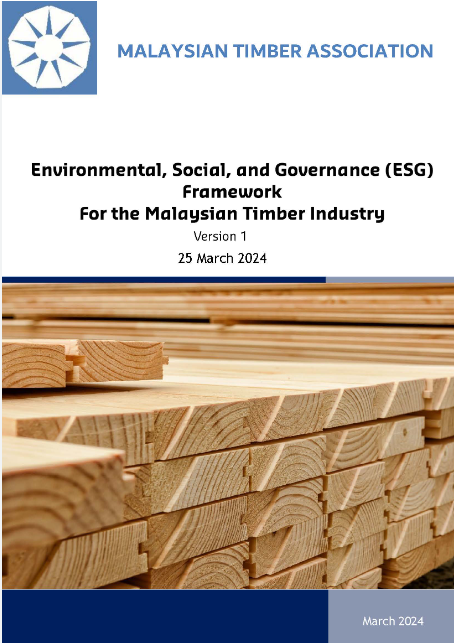
Malaysian Timber Association has engaged Control Union Malaysia to devise a customized ESG framework specifically for the Malaysian timber industry.
Understanding ESG in the timber industry
Environmental aspects
The timber industry's environmental footprint is substantial. Deforestation and forest degradation are significant challenges driven by the demand for timber and agricultural expansion. These activities contribute to climate change by releasing stored carbon, reducing the forest's capacity as a carbon sink. Moreover, they lead to biodiversity loss as habitats are destroyed and fragmented. Thus, the industry must address its role in climate change by reducing greenhouse gas emissions, enhancing carbon sequestration through forest conservation and restoration, and adapting to the impacts of climate change. Biodiversity conservation is essential for maintaining ecosystem health and resilience. Sustainable forest management practices, including reforestation, afforestation, and the protection of old-growth forests, are crucial for mitigating environmental impacts and ensuring the industry's long-term viability.
Social aspects
The timber industry has a profound social impact, particularly on indigenous communities and forest-dependent populations. Respecting indigenous peoples' rights, including land tenure, cultural heritage, and free, prior, and informed consent, is paramount(Baldwin Cantello, n.d.). Building solid relationships with local communities through engagement, consultation, and benefit-sharing is essential for social license operations. Ensuring fair labour practices, safe working conditions, and living wages throughout the supply chain is crucial for protecting workers' rights. Supply chain transparency and traceability are vital for addressing issues such as illegal logging, child labour, and forced labour. The industry can enhance its social reputation and promote sustainable development by fostering responsible sourcing and ethical practices.
Governance aspects
Effective governance is essential for the long-term success and sustainability of the timber industry. Strong corporate governance structures are fundamental, including independent boards of directors, precise accountability mechanisms, and transparent decision-making processes. Robust risk management systems are necessary to identify, assess, and mitigate environmental, social, and governance risks. Compliance with laws, regulations, and industry standards is essential for maintaining a solid reputation and avoiding legal liabilities. Engaging with diverse stakeholders, including investors, customers, employees, suppliers, and communities, is crucial for building trust, understanding expectations, and incorporating feedback into business strategies(Fadzil Abd Majid JPSM Dato et al., n.d.).
Implementation Challenges and Opportunities
Integrating ESG principles into the timber industry presents many challenges and opportunities. Economic pressures often prioritize short-term profits over long-term sustainability, hindering the adoption of ESG practices. Additionally, the lack of standardized ESG metrics and reporting frameworks can create difficulties in measuring and comparing company performance. Moreover, the remote and often inaccessible nature of forest operations can pose challenges for monitoring and enforcement.
Despite these hurdles, the timber industry also presents significant opportunities. Growing consumer demand for sustainable products and increasing investor interest in ESG performance drive market shifts. Technological advancements, such as remote sensing and blockchain, offer innovative solutions for improving transparency and traceability. Collaborations between industry stakeholders, governments, and civil society can foster a supportive environment for ESG implementation(Amran et al., 2014). By embracing these opportunities and addressing the challenges, the timber industry can position itself as a leader in sustainable development.
Case Studies and Best Practices
Identifying and analysing successful ESG implementation case studies within the timber industry is crucial for understanding effective strategies. These case studies should highlight companies that have demonstrated leadership in addressing environmental, social, and governance challenges. Other industry players can identify and replicate best practices by examining their approaches.
Key factors contributing to the success of these case studies should be meticulously analysed. These factors may include strong leadership commitment, robust ESG governance structures, innovative partnerships, and effective stakeholder engagement. Additionally, the role of certification schemes, such as the Forest Stewardship Council (FSC) and Programme for the Endorsement of Forest Certification (PEFC)(Sustainable Procurement - Giz.De, n.d.), in driving ESG performance should be explored.
Measurement and Reporting
Effective measurement and reporting of ESG performance are essential for driving continuous improvement within the timber industry. A robust ESG reporting framework allows companies to track progress, identify areas for enhancement, and communicate their sustainability efforts to stakeholders. However, the lack of standardized metrics and reporting guidelines can challenge data collection and analysis (Four Challenges of ESG Reporting | Blogs | Novisto, n.d.).
Existing ESG frameworks, such as the Global Reporting Initiative (GRI) Standards and the Sustainability Accounting Standards Board (SASB) standards, provide valuable guidance for the timber industry(GRI - Standards, n.d.; SASB Standards Overview - SASB, n.d.). These frameworks offer a structured approach to identifying ESG issues and disclosing relevant information to stakeholders(Elliot et al., 2024). Nevertheless, the industry-specific nature of timber operations necessitates the development of tailored metrics and indicators to capture the sector's unique environmental and social impacts.
Collecting and analysing ESG data can be complex and resource-intensive. Factors such as supply chain transparency, data quality, and access to information can hinder the process. Innovative data management and analysis tools can help to overcome these challenges and provide valuable insights for decision-making (Environmental, Social and Governance (ESG) Integration in Malaysia: Navigating Challenges and Embracing Opportunities for a Sustainable Future, 2023)
Future Trends and Recommendations
The timber industry is transforming rapidly, driven by evolving consumer preferences, technological advancements, and increasing regulatory scrutiny. Emerging ESG issues, such as climate-related risks, biodiversity loss, and social inequality, will continue to shape the industry's trajectory (Environmental, Social and Governance (ESG) Integration in Malaysia: Navigating Challenges and Embracing Opportunities for a Sustainable Future, 2023).
To address these challenges and capitalize on emerging opportunities, policymakers, industry stakeholders, and researchers must collaborate to drive positive change. Policy frameworks that support sustainable forest management, carbon pricing, and supply chain transparency are essential. Industry-led initiatives like collective action platforms and sustainability standards can accelerate progress. Additionally, investments in research and development are needed to advance sustainable technologies and practices.
As policy and regulatory developments play a crucial role in driving ESG adoption. Governments can incentivize sustainable practices, impose penalties for non-compliance, and create enabling environments for innovation(Environmental, Social and Governance (ESG) Integration in Malaysia: Navigating Challenges and Embracing Opportunities for a Sustainable Future, 2023). International collaboration is essential for addressing global challenges such as deforestation and illegal logging(UN-REDD Programme 2023 Annual Report, 2023).
Future research should focus on developing robust ESG metrics and reporting standards tailored to the timber industry, exploring the impact of ESG performance on financial returns, and assessing the effectiveness of different policy interventions. To foster sustainable practices, future research should focus on developing innovative solutions for reducing the industry's environmental footprint, enhancing social impacts, and improving governance practices(Li et al., 2021). Additionally, exploring the potential of emerging technologies, such as artificial intelligence and satellite imagery, to monitor forest ecosystems and combat illegal logging is essential (Forest Monitoring, Land Use & Deforestation Trends | Global Forest Watch, n.d.; Raihan, 2023).
By embracing ESG principles, the timber industry can contribute to a more sustainable future while building resilience and creating long-term value. Collaboration among industry stakeholders, policymakers, and civil society is essential for achieving these goals.
References
Amran, A., Lee, S. P., & Devi, S. S. (2014). The influence of governance structure and strategic corporate social responsibility toward sustainability reporting quality. Business Strategy and the Environment, 23(4), 217–235. https://doi.org/10.1002/BSE.1767
Baldwin Cantello, H. (n.d.). The Forest Pathways Report WWF 2023. Retrieved August 3, 2024, from www.millerdesign.co.uk
Elliot, V., Jonäll, K., Paananen, M., Bebbington, J., & Michelon, G. (2024). Biodiversity reporting: standardization, materiality, and assurance. Current Opinion in Environmental Sustainability, 68, 101435. https://doi.org/10.1016/J.COSUST.2024.101435
Environmental, Social and Governance (ESG) Integration in Malaysia: Navigating Challenges and Embracing Opportunities for a Sustainable Future. (2023).
ESG 101: What Does Social in ESG Mean? | Blog | OneTrust. (n.d.). Retrieved August 3, 2024, from https://www.onetrust.com/blog/esg-101-what-does-social-in-esg-mean/
ESG: environmental, social, & governance investing explained. (n.d.). Retrieved August 3, 2024, from https://www.imd.org/blog/sustainability/esg-environmental-social-and-governance/
Forest Monitoring, Land Use & Deforestation Trends | Global Forest Watch. (n.d.). Retrieved August 3, 2024, from https://www.globalforestwatch.org/
Four Challenges of ESG Reporting | Blogs | Novisto. (n.d.). Retrieved August 3, 2024, from https://novisto.com/resources/blogs/challenges-of-esg-reporting-and-strategies
GRI - Standards. (n.d.). Retrieved August 3, 2024, from https://www.globalreporting.org/standards/
Li, T. T., Wang, K., Sueyoshi, T., & Wang, D. D. (2021). ESG: Research Progress and Future Prospects. Sustainability 2021, Vol. 13, Page 11663, 13(21), 11663. https://doi.org/10.3390/SU132111663
Raihan, A. (2023). Artificial intelligence and machine learning applications in forest management and biodiversity conservation. Natural Resources Conservation and Research, 6(2), 3825. https://doi.org/10.24294/NRCR.V6I2.3825
SASB Standards overview - SASB. (n.d.). Retrieved August 3, 2024, from https://sasb.ifrs.org/standards/
Sustainable procurement - giz.de. (n.d.). Retrieved August 3, 2024, from https://www.giz.de/en/aboutgiz/90825.html
Understanding forest governance - Forest Governance Index. (n.d.). Retrieved August 3, 2024, from https://fgi.efi.int/why-forest-governance-is-important/understanding-forest-governance/
UN-REDD Programme 2023 Annual Report. (n.d.).
What is ESG? Environmental, Social, and Governance | Workiva. (n.d.). Retrieved August 3, 2024, from https://www.workiva.com/en-au/resources/what-is-esg-environmental-social-governance
What Is ESG Investing? (n.d.). Retrieved August 3, 2024, from https://www.investopedia.com/terms/e/environmental-social-and-governance-esg-criteria.asp
Amran, A., Lee, S. P., & Devi, S. S. (2014). The influence of governance structure and strategic corporate social responsibility toward sustainability reporting quality. Business Strategy and the Environment, 23(4), 217–235. https://doi.org/10.1002/BSE.1767
Baldwin Cantello, H. (n.d.). The Forest Pathways Report WWF 2023. Retrieved August 3, 2024, from www.millerdesign.co.uk
Elliot, V., Jonäll, K., Paananen, M., Bebbington, J., & Michelon, G. (2024). Biodiversity reporting: standardization, materiality, and assurance. Current Opinion in Environmental Sustainability, 68, 101435. https://doi.org/10.1016/J.COSUST.2024.101435
Environmental, Social and Governance (ESG) Integration in Malaysia: Navigating Challenges and Embracing Opportunities for a Sustainable Future. (2023).
ESG 101: What Does Social in ESG Mean? | Blog | OneTrust. (n.d.). Retrieved August 3, 2024, from https://www.onetrust.com/blog/esg-101-what-does-social-in-esg-mean/
ESG: environmental, social, & governance investing explained. (n.d.). Retrieved August 3, 2024, from https://www.imd.org/blog/sustainability/esg-environmental-social-and-governance/
Forest Monitoring, Land Use & Deforestation Trends | Global Forest Watch. (n.d.). Retrieved August 3, 2024, from https://www.globalforestwatch.org/
Four Challenges of ESG Reporting | Blogs | Novisto. (n.d.). Retrieved August 3, 2024, from https://novisto.com/resources/blogs/challenges-of-esg-reporting-and-strategies
GRI - Standards. (n.d.). Retrieved August 3, 2024, from https://www.globalreporting.org/standards/
Li, T. T., Wang, K., Sueyoshi, T., & Wang, D. D. (2021). ESG: Research Progress and Future Prospects. Sustainability 2021, Vol. 13, Page 11663, 13(21), 11663. https://doi.org/10.3390/SU132111663
Raihan, A. (2023). Artificial intelligence and machine learning applications in forest management and biodiversity conservation. Natural Resources Conservation and Research, 6(2), 3825. https://doi.org/10.24294/NRCR.V6I2.3825
SASB Standards overview - SASB. (n.d.). Retrieved August 3, 2024, from https://sasb.ifrs.org/standards/
Sustainable procurement - giz.de. (n.d.). Retrieved August 3, 2024, from https://www.giz.de/en/aboutgiz/90825.html
Understanding forest governance - Forest Governance Index. (n.d.). Retrieved August 3, 2024, from https://fgi.efi.int/why-forest-governance-is-important/understanding-forest-governance/
UN-REDD Programme 2023 Annual Report. (n.d.).
What is ESG? Environmental, Social, and Governance | Workiva. (n.d.). Retrieved August 3, 2024, from https://www.workiva.com/en-au/resources/what-is-esg-environmental-social-governance
What Is ESG Investing? (n.d.). Retrieved August 3, 2024, from https://www.investopedia.com/terms/e/environmental-social-and-governance-esg-criteria.asp
Forestry investors need to take into account various ESG factors for both their direct and indirect investments.
