

Safeguarding Paradise: How the JPS River Index Protects Recreational Forests in Malaysia
Water quality status is evaluated by a water quality index (WQI), a single unitless number calculated using a formula that considers many water quality parameters (Nives 1999; Pesce & Wunderlin 2000). According to Khan et al. (2003), WQIs are based on comparing water quality parameters with established guidelines.
The water quality index allows us to assess water quality from various sources, helping us determine the best way to use the water resource. WQIs provide a comprehensive picture of overall water quality, making it easy to understand for everyone, even those without a scientific background. This information helps policymakers make more objective decisions and track changes in water quality over time.
WQIs comprise four steps. First, the most critical water quality parameters are chosen. Next, the concentrations for each parameter are converted to a single score. Then, each parameter is assigned a weighting factor based on its importance. Finally, all the scores and weights are combined to generate a final WQI.
The water quality index allows us to assess water quality from various sources, helping us determine the best way to use the water resource. WQIs provide a comprehensive picture of overall water quality, making it easy to understand for everyone, even those without a scientific background. This information helps policymakers make more objective decisions and track changes in water quality over time.
WQIs comprise four steps. First, the most critical water quality parameters are chosen. Next, the concentrations for each parameter are converted to a single score. Then, each parameter is assigned a weighting factor based on its importance. Finally, all the scores and weights are combined to generate a final WQI.

Safeguarding Paradise: Can crystal-clear water be the key to Malaysia
This article explores the JPS River Index (JRI) as a tool for evaluating water quality in Malaysia. Developed specifically for Malaysian rivers, the JRI goes beyond standard water quality indices by considering both the physical characteristics of the water and the river's flow rate (Yuslina et al., 2012).
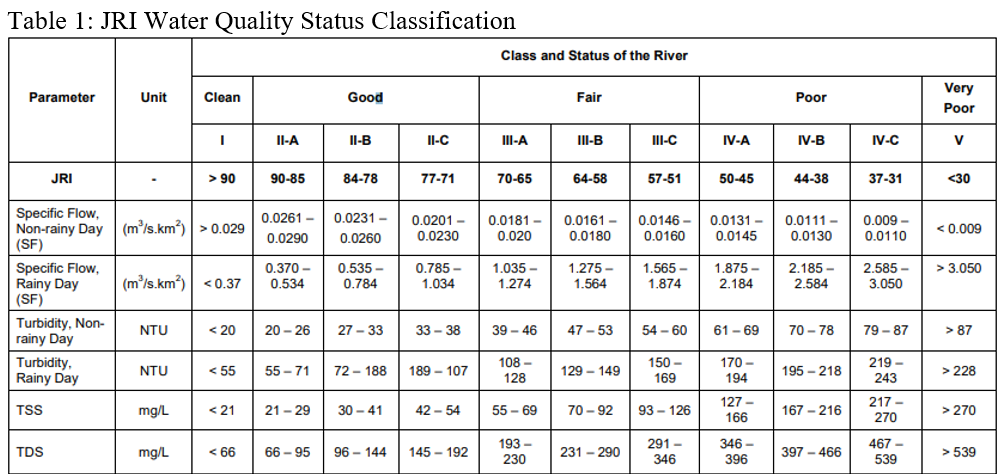
JRI uses four key indicators: turbidity, total suspended solids (TSS), total dissolved solids (TDS), and river flow (Abdullah, 2009). These indicators are measured under different weather conditions, allowing for a more comprehensive assessment (Department of Irrigation and Drainage, 2009).
Table 1 shows details of the specific parameters used in the JRI calculation and how factors like rain can affect the measurements. It also presents the five water quality classifications (clean, good, fair, poor, very poor) assigned by JRI based on the calculated index value (Hassan et al., 2015).
JRI uses four key indicators: turbidity, total suspended solids (TSS), total dissolved solids (TDS), and river flow (Abdullah, 2009). These indicators are measured under different weather conditions, allowing for a more comprehensive assessment (Department of Irrigation and Drainage, 2009).
Table 1 shows details of the specific parameters used in the JRI calculation and how factors like rain can affect the measurements. It also presents the five water quality classifications (clean, good, fair, poor, very poor) assigned by JRI based on the calculated index value (Hassan et al., 2015).
We mentioned that the JPS River Index (JRI) can check a river's physical health and how much water it can carry. Researchers used JRI to evaluate three rivers in a recreational forest area near Hulu Langat, Selangor, to see this in action. They collected water samples multiple times over two months, with consistent gaps between each sample. Table 2 shows the fascinating results of this study.
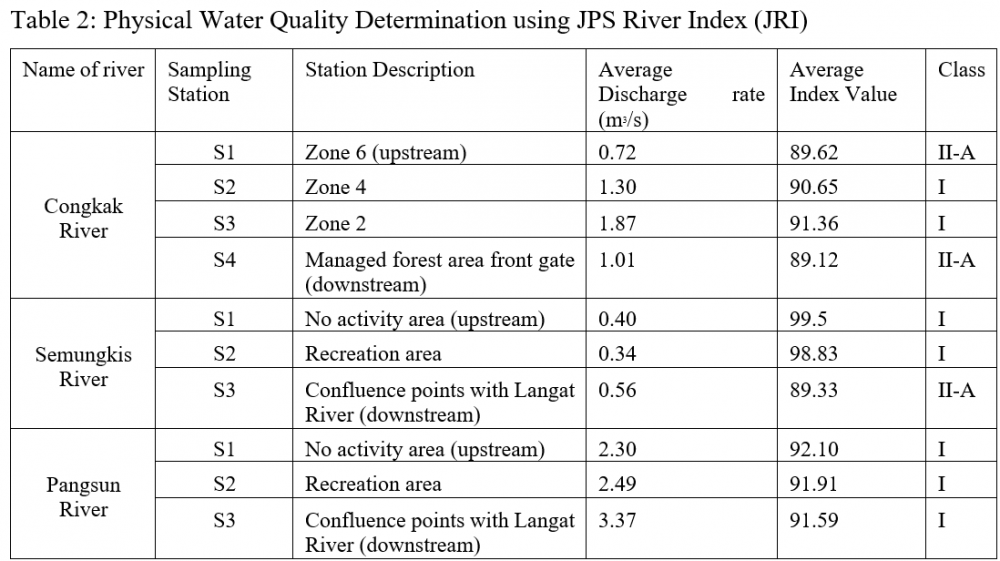
The JRI results (Table 2) are encouraging! All three rivers showed clean or good physical water quality, falling under Class I or Class II-A according to the JPS River Index. This suggests minimal pollution and a healthy environment for aquatic life.
Regarding water flow, the Pangsun River seems to be the champion. It contributes the highest volume of water to the Langat River, ranging from 2.30 to 3.40 cubic meters. This information is crucial for managing water resources and understanding the overall health of the river system.
References
Abdullah A.M (2009). Study on The River Water Quality Trends and Indexes in Peninsular Malaysia 2009 Water Resources Management and Hydrology Division Department of Irrigation and Drainage Ministry of Natural Resources and Environment Malaysia. Retrieved from http://h2o.water.gov.my/man_water/WRP21.pdf
Ewaid S. H., Abed S. A., Al-Ansari N., & Salih R. M. (2020). Development and Evaluation of a Water Quality Index for the Iraqi Rivers. Hydrology, 7(3):67. https://doi.org/10.3390/hydrology7030067
Hasan, Hasrul, H. & Jamil, Rohaizah, N., and Aini, F. (2015). Water quality index and sediment loading analysis in Pelus River, Perak, Malaysia. Procedia Environmental Sciences, 30. pp. 133-138. https://doi.org/10.1016/j.proenv.2015.10.024
Khan, F., Husain, T., & Lumb, A. (2003). Water quality evaluation and trend analysis in selected watersheds of the Atlantic region of Canada. Environmental Monitoring and Assessment, 88(1–3), 221–242. https://doi.org/10.1023/A:1025573108513
Mohd Amir Haiqal, M. S. (2024). Quantity and Physical Water Quality Status of Semungkis River, Hulu Langat, Selangor. Bachelor’s degree Thesis. Faculty of Forestry and Environment, UPM: Serdang
Muhammad Syahir Afham, R. (2024). Water Quantity and Quality Status of Sungai Pangsun, Hulu Langat, Selangor. Bachelor’s degree Thesis. Faculty of Forestry and Environment, UPM: Serdang
Nives S. G., (1999). Water quality evaluation by index in Dalamatia. Water Res., 33, 3423–3440
Pesce S.F. and Wunderlin D. A., (2000). Use water quality indices to verify the impact of Cordoba City (Argentina) on the Suquia River. Water Res., 34, 2915–2926
Siti Nurhaafizhah, M. I. (2020). Water Quantity and Status of Physical Water Quality of Sungai Congkakin Forest Managed Area using JPS River Index. Bachelor’s degree Thesis. Faculty of Forestry and Environment, UPM: Serdang
Uddin, M. G., Nash, S., & Olbert, A. I. (2021). A review of water quality index models and their use for assessing surface water quality. Ecological Indicators, 122, 107218, https://doi.org/10.1016/j.ecolind.2020.107218
Yuslina et al. (2012). Cabaran Inovasi Jps 2012 Tajuk : Pengukuran Kualiti Air Sungai Berdasarkan Jps River Index (Jri) Di Lembangan Sungai Klang Kategori : Pengurusan Bersama Swasta. Retrieved from http://habinovasi.mampu.gov.my/laporan_inovasi/824-pengukuran-kualiti-air-sungai-berdasarkan-jps-river-index-jri-di-lembangan-sungai-klang.pdf
Regarding water flow, the Pangsun River seems to be the champion. It contributes the highest volume of water to the Langat River, ranging from 2.30 to 3.40 cubic meters. This information is crucial for managing water resources and understanding the overall health of the river system.
References
Abdullah A.M (2009). Study on The River Water Quality Trends and Indexes in Peninsular Malaysia 2009 Water Resources Management and Hydrology Division Department of Irrigation and Drainage Ministry of Natural Resources and Environment Malaysia. Retrieved from http://h2o.water.gov.my/man_water/WRP21.pdf
Ewaid S. H., Abed S. A., Al-Ansari N., & Salih R. M. (2020). Development and Evaluation of a Water Quality Index for the Iraqi Rivers. Hydrology, 7(3):67. https://doi.org/10.3390/hydrology7030067
Hasan, Hasrul, H. & Jamil, Rohaizah, N., and Aini, F. (2015). Water quality index and sediment loading analysis in Pelus River, Perak, Malaysia. Procedia Environmental Sciences, 30. pp. 133-138. https://doi.org/10.1016/j.proenv.2015.10.024
Khan, F., Husain, T., & Lumb, A. (2003). Water quality evaluation and trend analysis in selected watersheds of the Atlantic region of Canada. Environmental Monitoring and Assessment, 88(1–3), 221–242. https://doi.org/10.1023/A:1025573108513
Mohd Amir Haiqal, M. S. (2024). Quantity and Physical Water Quality Status of Semungkis River, Hulu Langat, Selangor. Bachelor’s degree Thesis. Faculty of Forestry and Environment, UPM: Serdang
Muhammad Syahir Afham, R. (2024). Water Quantity and Quality Status of Sungai Pangsun, Hulu Langat, Selangor. Bachelor’s degree Thesis. Faculty of Forestry and Environment, UPM: Serdang
Nives S. G., (1999). Water quality evaluation by index in Dalamatia. Water Res., 33, 3423–3440
Pesce S.F. and Wunderlin D. A., (2000). Use water quality indices to verify the impact of Cordoba City (Argentina) on the Suquia River. Water Res., 34, 2915–2926
Siti Nurhaafizhah, M. I. (2020). Water Quantity and Status of Physical Water Quality of Sungai Congkakin Forest Managed Area using JPS River Index. Bachelor’s degree Thesis. Faculty of Forestry and Environment, UPM: Serdang
Uddin, M. G., Nash, S., & Olbert, A. I. (2021). A review of water quality index models and their use for assessing surface water quality. Ecological Indicators, 122, 107218, https://doi.org/10.1016/j.ecolind.2020.107218
Yuslina et al. (2012). Cabaran Inovasi Jps 2012 Tajuk : Pengukuran Kualiti Air Sungai Berdasarkan Jps River Index (Jri) Di Lembangan Sungai Klang Kategori : Pengurusan Bersama Swasta. Retrieved from http://habinovasi.mampu.gov.my/laporan_inovasi/824-pengukuran-kualiti-air-sungai-berdasarkan-jps-river-index-jri-di-lembangan-sungai-klang.pdf
